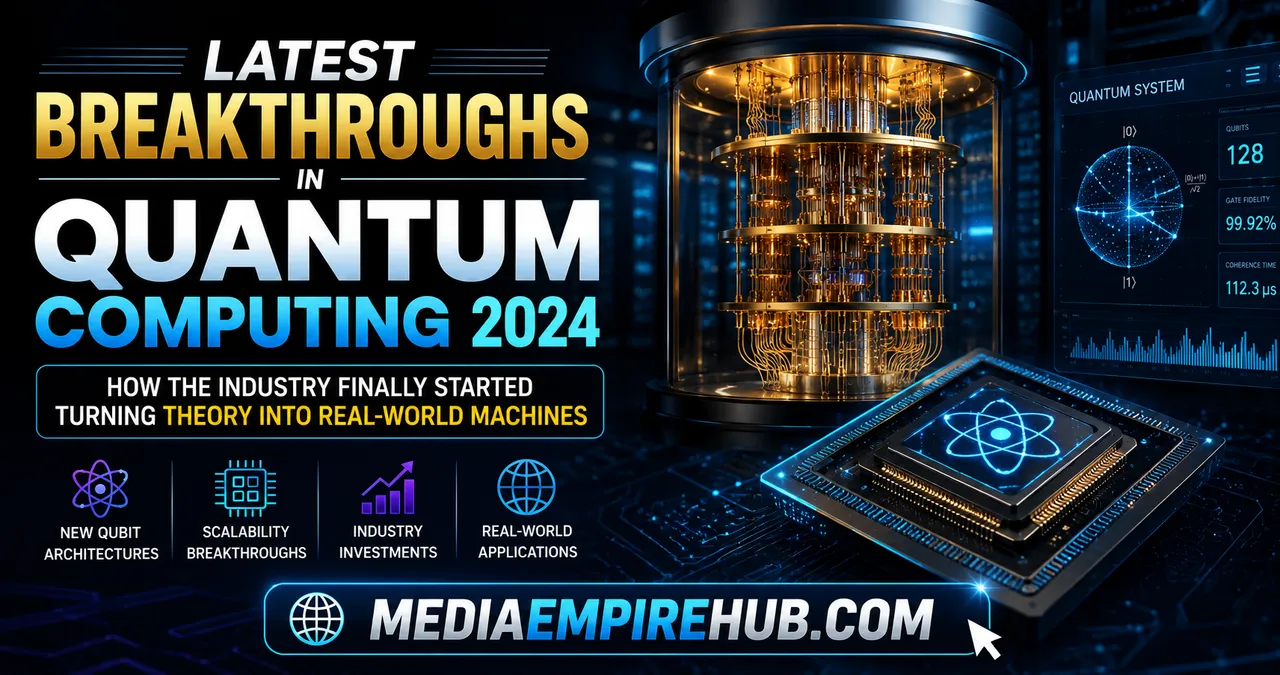
For over a decade, quantum computing was a field defined by intoxicating promises and stubborn physical realities. We were told of a future where molecular modeling, computational chemistry, and unbreakable cryptography would unlock next-generation industries. Yet, in practice, the machines remained fragile. They were noisy, prone to decoherence, and highly susceptible to the slightest thermal or electromagnetic interference.
That narrative shifted permanently. The industry looks back at 2024 as the year the field pivoted from noisy, experimental hardware to fault-tolerant, resilient logical systems.
Instead of merely competing on raw, physical qubit counts, the world’s leading quantum computing institutions and enterprises—including IBM Quantum, Google Quantum AI, Microsoft Quantum, Quantinuum, and Harvard University—shifted their focus to quantum error correction (QEC) and logical qubit virtualization. The results were staggering. In 2024, we witnessed physical-to-logical qubit ratio compressions, active mid-circuit error detection, and the first clear experimental demonstrations of logical qubits outperforming their physical counterparts.
This is the comprehensive story of the Latest Breakthroughs in Quantum Computing 2024, detailing the hardware, software, algorithms, and real-world milestones that have set us on an accelerated path toward the fault-tolerant era.
What Is Quantum Computing?
To appreciate the gravity of recent breakthroughs, it is essential to establish how quantum computing departs from the classical architectures that run our modern world.
A classical supercomputer, no matter how massive, processes information sequentially using bits. A bit is binary; it can only exist in one of two definite states: $0$ or $1$.
A quantum computer, conversely, leverages the fundamental laws of quantum mechanics to process information in a completely different way. Rather than using classical silicon transistors, a quantum computer uses quantum hardware to manipulate subatomic particles—such as electrons, ions, or photons—which act as quantum bits, or qubits.
Qubits operate on three core principles:
- Superposition: Unlike a classical bit, a qubit can exist in a linear combination of both states ($\vert{}0\rangle$ and $\vert{}1\rangle$) simultaneously. This allows a quantum computer to represent and evaluate a vast number of computational possibilities at once.
- Entanglement: This is a uniquely quantum phenomenon where two or more qubits become deeply linked. The state of one qubit instantaneously influences the state of another, even if they are physically separated. Entanglement allows the system to process complex, highly correlated data structures that would stall classical machines.
- Interference: Quantum algorithms use interference to amplify the correct mathematical paths leading to the solution of a problem while canceling out the incorrect paths.
Classical Bit:   [0]  OR  [1]           (Like a light switch: either On or Off)

Quantum Qubit:   a|0⟩ + b|1⟩          (Like a spinning coin: representing both 0 and 1 simultaneously)
By combining these principles, a quantum computer can solve highly complex mathematical problems that scale exponentially. However, qubits are exceptionally delicate. The slightest environmental disruption—a minor temperature fluctuation, a stray electromagnetic wave, or even a microscopic vibration—causes decoherence, destroying the quantum state and corrupting the calculation. This fragility is why the breakthroughs of 2024, which focus primarily on correcting these errors, are so revolutionary.
The Coding Behind the Simulation: Check out how physics engines translate real-world mechanics into digital space over at MediaEmpireHub: Future of Interactive Tech.
Why 2024 Was a Milestone Year for Quantum Computing
If the period between 2019 and 2023 was characterized by the pursuit of quantum supremacy—proving a quantum machine could perform a highly specific, albeit practically useless, mathematical task faster than a classical supercomputer—then 2024 was the year of quantum utility and resilience.
Before 2024, quantum computing existed almost entirely in the Noisy Intermediate-Scale Quantum (NISQ) era. In this phase, researchers had to write algorithms around the high error rates of raw, uncorrected physical qubits.
In 2024, the paradigm broke open. Instead of celebrating processors simply because they contained hundreds of noisy physical qubits, the industry celebrated logical qubits. A logical qubit is a “virtual” qubit created by entangling a large cluster of physical qubits together. By distributing the quantum information across this group, the system can detect when a physical qubit undergoes a state change (an error) and correct it in real-time without destroying the overall calculation.
The breakthroughs of 2024 proved that:
- We can construct logical qubits that exhibit error rates orders of magnitude lower than their underlying physical components.
- The hardware overhead required to create these logical qubits is much lower than previously assumed, collapsing the timeline to commercial utility.
- Real-time “active syndrome extraction”—detecting errors mid-circuit without halting the computer—is fully achievable on commercial hardware.
Major Company & Institutional Breakthroughs in 2024
The global race for quantum dominance is no longer a theoretical exercise. In 2024, major technology conglomerates, agile hardware startups, and leading academic labs delivered concrete engineering milestones.
Microsoft Quantum & Quantinuum: The 800x Error Reduction
In April 2024, Microsoft and Quantinuum announced a joint milestone that many researchers did not expect to see for years. Utilizing Microsoft’s advanced qubit-virtualization system alongside Quantinuum’s System Model H2 (a 32-qubit trapped-ion processor), the teams successfully created four highly reliable logical qubits from just 30 physical qubits.
The results shattered previous performance records:
- The logical qubits demonstrated error rates 800 times lower than the corresponding physical error rates of the H2 processor.
- The system ran over 14,000 independent instances of a quantum circuit completely error-free.
- They successfully performed multiple rounds of active syndrome extraction, proving that errors could be detected, isolated, and bypassed on the fly.
This achievement fundamentally challenged the industry consensus that thousands of noisy physical qubits would be required to yield a single, reliable logical qubit, accelerating the arrival of resilient quantum software.
IBM Quantum: Scaling “Heron” and the Era of Quantum Utility
Throughout 2024, IBM focused on proving that its quantum systems could serve as useful computational tools even before achieving full fault-tolerance.
Building on its late-2023 debut of the IBM Heron processor (a 133-qubit superconducting chip), IBM deployed its next-generation iterations, including the Heron r2 and Heron r3 processors. These upgraded quantum chips featured:
- A physical design that dramatically reduced “cross-talk” errors—where the operation of one qubit inadvertently alters its neighbor.
- An instruction limit that successfully executed circuits up to 5,000 gates long.
- High-efficiency integration with Qiskit, IBM’s open-source quantum software development kit, which was optimized in 2024 to use artificial intelligence for transpilation (automatically shortening and streamlining quantum circuits to reduce error exposure).
IBM’s 2024 focus shifted toward connecting multiple Heron chips using modular quantum interconnects, establishing a clear pathway toward scaling processors into “quantum-centric supercomputers.”
Google Quantum AI: Willow and Below-Threshold Error Correction
In December 2024, Google Quantum AI unveiled its newest state-of-the-art superconducting processor: Willow.
Willow is a 105-qubit superconducting chip fabricated in-house at Google’s Santa Barbara facility. With Willow, Google achieved a highly anticipated, historic milestone in quantum error correction: below-threshold operation.
In a quantum error-correcting code, there is a theoretical “threshold.” If your physical qubits are of poor quality, adding more physical qubits to a logical group actually increases the chance of an error occurring. However, if your physical qubits are below this quality threshold, adding more physical qubits reduces the logical error rate. On Willow, Google experimentally proved that a larger surface code (scaling up the physical qubit footprint) successfully lowered the overall logical error rate. This is an essential validation of the fundamental theory behind building a million-qubit, fault-tolerant machine.
Harvard University, MIT, and QuEra: Reconfigurable Neutral-Atom Logical Arrays
In a landmark paper published in Nature in early 2024, researchers from Harvard University, the Massachusetts Institute of Technology (MIT), and Boston-based startup QuEra Computing announced the creation of a highly programmable, fault-tolerant quantum processor operating on reconfigurable neutral-atom arrays.
The team successfully:
- Encoded up to 48 logical qubits from an array of 280 physical rubidium atoms.
- Demonstrated highly complex, entangled logical operations.
- Pioneered dynamical atom rearrangement, which allowed researchers to physically move qubits around mid-circuit using optical laser tweezers to execute logical gates between distant qubits.
This work established neutral-atom systems as a primary contender in the race for large-scale, fault-tolerant quantum computing.
IonQ & Rigetti Computing: Scaling Commercial QPU Portfolios
Other pure-play quantum companies pushed their respective hardware architectures to new commercial heights in 2024:
- IonQ focused on high-accuracy trapped-ion architectures, hitting key algorithmic fidelity metrics with its Forte and Tempo platforms, targeting high-reliability operations for enterprise clients in finance and logistics.
- Rigetti Computing pushed forward with its Ankaa-series superconducting processors, demonstrating improved two-qubit gate fidelities and advancing modular multi-chip architectures to scale up qubit counts without introducing debilitating noise.
Quantum Hardware Advances: The 2024 Landscape
A primary challenge in quantum computing is that there is no “silicon standard” yet. Several distinct hardware modalities are competing for dominance, each relying on different physical systems to construct, trap, and manipulate qubits.
In 2024, each modality achieved significant breakthroughs, refining its unique advantages while addressing critical engineering bottlenecks.
Superconducting Qubits
Superconducting systems use microscopic electrical circuits fabricated on silicon chips. These circuits are made of superconducting materials (like niobium or aluminum) that exhibit zero electrical resistance when cooled to temperatures near absolute zero (approx. 10 millikelvin). The qubits, typically called transmons, are manipulated using microwave pulses.
- 2024 Progress: Google’s Willow chip and IBM’s Heron processors drastically improved two-qubit gate fidelities. They also achieved “below-threshold” physical error scaling.
- Advantages: Extremely fast gate operation speeds (nanosecond scale); built using mature semiconductor fabrication techniques, allowing for easier chip design and production.
- Limitations: Requires massive, power-hungry dilution refrigerators; qubits must be physically wired, creating a severe scaling bottleneck (the “wiring bottleneck”); high susceptibility to environmental noise and crosstalk.
Trapped Ion Qubits
Trapped-ion systems utilize individual, electrically charged atoms (ions)—such as ytterbium or barium—as qubits. These ions are suspended in a vacuum chamber by electromagnetic fields and manipulated using highly precise laser beams.
- 2024 Progress: Quantinuum’s System Model H2, utilizing a Quantum Charge-Coupled Device (QCCD) architecture, demonstrated 99.8% two-qubit gate fidelities and all-to-all connectivity, which made the Microsoft virtual-qubit compression possible.
- Advantages: Identical, natural qubits with long coherence times; every qubit can interact with every other qubit in the trap (all-to-all connectivity).
- Limitations: Slower gate operation speeds compared to superconducting chips; scaling requires complex optical systems to route thousands of individual laser beams into a vacuum trap.
Neutral Atom Qubits
Neutral-atom systems use uncharged atoms (such as rubidium or strontium) suspended in a vacuum chamber and held in place by tightly focused laser beams called “optical tweezers”. When excited by lasers to a highly energized “Rydberg state,” their electron clouds expand, allowing them to interact over long distances.
- 2024 Progress: Harvard, MIT, and QuEra demonstrated the largest array of logical qubits to date (48) using dynamic atom rearrangement. Atom Computing successfully scaled physical neutral-atom arrays beyond 1,000 qubits.
- Advantages: Qubits are highly identical and packed tightly at room temperature (no cryogenics needed for the atoms themselves); qubits can be physically moved mid-circuit using optical tweezers.
- Limitations: Loading and trapping thousands of atoms in optical arrays is highly complex; slower cycle times compared to superconducting architectures.
Photonic Systems
Photonic quantum computing uses single particles of light (photons) as qubits. These photons travel through microscopic waveguides etched into silicon chips, with operations performed using beam splitters, phase shifters, and highly sensitive optical detectors.
- 2024 Progress: Companies like PsiQuantum made significant progress in designing large-scale silicon photonic chips. They secured major government-backed funding to build utility-scale photonic quantum computers, demonstrating high-efficiency photon generation and low-loss optical switches.
- Advantages: Photons do not require cryogenic cooling to remain coherent (can operate at room temperature); they are immune to electromagnetic interference and can naturally integrate into fiber-optic telecommunication lines for quantum networking.
- Limitations: Photons do not easily interact with one another, making two-qubit logic gates exceptionally difficult to implement; high rate of photon loss requires extreme hardware redundancy.
Silicon Spin Qubits
Silicon spin qubits trap single electrons within tiny semiconductor structures called quantum dots, which are fabricated on standard silicon wafers. The qubit is defined by the spin state (spin-up or spin-down) of the trapped electron.
- 2024 Progress: Academic labs and corporate chipmakers (including Intel) demonstrated high-fidelity two-qubit operations on silicon-based quantum dots fabricated on existing 300mm commercial manufacturing lines.
- Advantages: Can leverage the multi-trillion-dollar global semiconductor manufacturing infrastructure, promising unmatched physical scalability and integration with classical microchips.
- Limitations: The physics of controlling single-electron spins is incredibly sensitive to microscopic material impurities; requires cryogenics (though slightly warmer than superconducting systems).
Quantum Error Correction: Why It Matters Now
To understand why the industry is so focused on quantum error correction, it helps to look at the numbers.
In classical computing, the hardware error rate of a modern transistor is roughly 1 in $10^{17}$ operations. This is so low that classical computers can run for years without experiencing a single hardware fault.
In quantum computing, a state-of-the-art physical qubit has an error rate of roughly 1 in $1,000$ operations (a gate fidelity of 99.9%). If a quantum algorithm requires 1,000,000 steps to solve a complex chemical simulation, running it on raw physical qubits will result in absolute, garbled noise.
       +------------------------------------+
       |  Raw Physical Qubits (Noisy)       | ---> Error Rate: ~1 in 1,000
       +------------------------------------+
                         |
                         v [Quantum Error Correction / Active Decoding]
                         |
       +------------------------------------+
       |  Logical Qubits (Resilient)        | ---> Error Rate: ~1 in 1,000,000+
       +------------------------------------+
The Transition to Logical Qubits
In 2024, the scientific community proved that QEC is no longer a theoretical dream. The basic mechanism involves:
- Entangling Physical Qubits: Grouping multiple physical qubits together into a single logical unit.
- Syndrome Extraction: Measuring auxiliary (or “ancilla”) qubits to detect whether any physical qubits have flipped their states, without directly measuring the data qubits (which would collapse the superposition).
- Active Decoding: Using classical processors to interpret these error signals and apply corrective operations in real-time.
The Quantinuum and Microsoft breakthrough in 2024 showed that by using an advanced virtualization layer, they could reduce the overhead ratio to only 7.5 physical qubits per logical qubit (30 physical to 4 logical), achieving a massive $800\times$ error rate reduction. This crushed old projections that suggested we would need 1,000 physical qubits for every single logical qubit, bringing the commercial timeline of fault-tolerant quantum computing forward by years.
The Reality of Emerging Tech Trends: Just as quantum breakthroughs require strict experimental validation, navigating other trending online tech and crypto spaces requires extreme caution. To understand how to safely research and verify unconfirmed digital platforms, read our guide on Bitclassic Applewhite and Online Search Trends.
Quantum Algorithms: Shifting Gears in 2024
As quantum hardware matured in 2024, the development of quantum algorithms transitioned from abstract mathematical proofs to highly optimized, application-specific software.
Optimization
Many of the world’s most complex logistical and financial problems are optimization challenges—finding the absolute best solution out of a near-infinite number of possibilities. In 2024, researchers refined Quantum Approximate Optimization Algorithms (QAOA) to run more efficiently on early error-corrected machines. These algorithms are designed to tackle problems like global supply chain routing, electrical grid distribution, and portfolio risk management with much higher accuracy than classical heuristics can manage.
Quantum Chemistry and Materials Science
Simulating how molecules interact is exceptionally difficult for classical computers because the quantum states of electrons scale exponentially with the size of the molecule. In 2024, the introduction of stable logical qubits allowed researchers to perform highly precise simulations of chemical structures. Progress focused on:
- Nitrogen Fixation: Simulating the FeMoco cluster, a highly complex enzyme that bacteria use to convert nitrogen into ammonia. Cracking this process could revolutionize global fertilizer production, which currently consumes roughly 1-2% of the world’s energy.
- Battery Chemistry: Modeling next-generation solid-state battery materials to increase energy density and accelerate EV adoption.
Cryptography
A major concern surrounding the development of quantum computers is their potential to break modern asymmetric encryption (like RSA) using Shor’s Algorithm. In 2024, the focus shifted toward testing and deploying Post-Quantum Cryptography (PQC) standards. While a cryptographically relevant quantum computer is still years away, the transition to quantum-resistant algorithms became a national security priority for governments and financial institutions worldwide.
Quantum Machine Learning (QML)
Quantum Machine Learning algorithms seek to use superposition and entanglement to analyze high-dimensional datasets far more rapidly than classical neural networks. In 2024, researchers demonstrated that early logical processors could dramatically speed up the training of certain deep-learning models, particularly in identifying complex patterns within biological and financial datasets.
Real-World Applications: From Lab to Market
The breakthroughs of 2024 are already trickling down to industrial use cases, with multi-national corporations partnering with quantum cloud providers to run proof-of-concept workflows.
- Pharmaceuticals & Drug Discovery: Developing a new drug currently takes over a decade and billions of dollars, largely due to trial-and-error laboratory testing. In 2024, pharmaceutical giants used quantum simulators to model molecular docking—predicting how candidate drug molecules bind to target proteins. This drastically narrows down the pool of compound candidates before physical laboratory testing even begins.
- Finance & Portfolio Optimization: Global investment banks are utilizing hybrid quantum-classical algorithms to optimize massive portfolios, calculate real-time Value-at-Risk (VaR) models, and run high-efficiency Monte Carlo simulations to detect subtle market anomalies.
- Logistics & Supply Chain: Shipping and aerospace companies are exploring quantum algorithms to optimize maritime routes, minimize empty-trip mileage for cargo fleets, and solve complex scheduling bottlenecks at global transit hubs.
- Climate Modeling: Quantum computers are uniquely suited to modeling complex atmospheric chemistry. In 2024, environmental scientists developed early quantum models to simulate carbon-capture materials, aiming to design catalysts that can pull carbon dioxide directly out of the atmosphere far more efficiently.
- Manufacturing & Materials Science: From designing lighter, stronger composite materials for aerospace engineering to creating high-efficiency catalysts for industrial manufacturing, quantum computing is helping companies simulate atomic-level structures to bypass physical prototyping.
Comparative Analysis of Major Quantum Computing Players
The table below provides a detailed comparison of the leading enterprises pushing the boundaries of quantum hardware and software.
| Company | Hardware Modality | Qubit Type | Major Achievement | Primary Strategic Focus | Key Strengths |
| IBM Quantum | Superconducting | Transmon | Heron r3 processor (5,000 gate limits) | Modular scale-up and Quantum Utility | Mature developer ecosystem (Qiskit); cloud-scale accessibility |
| Google Quantum AI | Superconducting | Transmon | Willow chip below-threshold error correction | Building a 1-million physical qubit fault-tolerant system | Industry-leading chip fabrication; deep algorithmic expertise |
| Microsoft Quantum | Trapped Ion / Topological | Virtual Logical Qubits | $800\times$ physical-to-logical error reduction with Quantinuum | Hybrid classical-quantum cloud infrastructure (Azure Quantum) | Advanced qubit-virtualization software and error-correction theory |
| Quantinuum | Trapped Ion | Barium / Ytterbium | System Model H2 with 99.8% two-qubit gate fidelity | High-fidelity hardware scaling | World-record physical gate fidelities; all-to-all qubit connectivity |
| QuEra Computing | Neutral Atom | Rubidium Atoms | 48 logical qubits created via reconfigurable atom arrays | Large-scale fault-tolerant neutral atom processors | Dynamical atom rearrangement using optical tweezers |
| Rigetti Computing | Superconducting | Transmon | Ankaa-series processor performance optimizations | Scalable multi-chip modular QPUs | Cost-effective manufacturing; strong hybrid-classical architecture |
| IonQ | Trapped Ion | Ytterbium Ions | High-fidelity algorithmic qubits on Forte and Tempo | Enterprise-grade rack-mounted QPUs | Long qubit coherence times; cloud system integration |
Key Challenges Facing the Industry
Despite the historic breakthroughs of 2024, the path to a universally applicable, error-free quantum supercomputer is still blocked by formidable engineering and economic hurdles.
1. The Scaling Bottleneck
To run highly complex algorithms, we need millions of physical qubits. For superconducting chips, this means packing millions of individual microwave control cables into a dilution refrigerator, which presents severe physical space constraints. While modular quantum interconnects (such as IBM’s m-couplers) are designed to bridge multiple separate processors, creating low-loss quantum links remains exceptionally difficult.
2. High Cryogenic & Operational Costs
Most quantum systems require temperatures of roughly 10 millikelvin—colder than deep space. Keeping these systems cold requires massive, liquid-helium-powered cryostats that consume significant amounts of electricity. This high overhead makes operating quantum hardware extraordinarily expensive compared to classical data centers.
3. The Classical Decoder Bottleneck
As quantum error correction operates in real-time, the classical computers reading the “syndrome measurements” must interpret billions of error signals per second and calculate corrections within microseconds. If the classical decoder cannot keep pace with the quantum processor’s operational speed, the system stalls, neutralizing the quantum advantage.
4. Software & Talent Shortages
Building quantum-centric supercomputers requires a highly specialized workforce that blends physics, materials science, computer engineering, and advanced mathematics. There is a severe global shortage of quantum software engineers who can design and transpile algorithms optimized for early logical processors.
Future Outlook: The Next Five Years
As we look toward the end of the decade, the quantum computing roadmap has become highly structured and predictable.
       [2024]                      [2026-2027]                      [2029-2030]
  Early Resilient Era          Distributed Quantum Systems     Commercial Fault-Tolerance
  (4 to 48 Logical Qubits)   (Parallel CPUs & Optical Links)   (10,000+ Logical Qubits)
By 2026-2027, we expect to see the widespread deployment of distributed quantum computing. Rather than trying to cram more qubits onto a single piece of silicon, companies will link multiple independent quantum processing units (QPUs) using high-speed optical fiber interconnects. This modular scaling will allow data centers to chain processors together to handle much larger workloads.
By 2029-2030, we anticipate the first fully fault-tolerant, commercial-scale quantum systems. These machines will control upwards of 10,000 highly resilient logical qubits, allowing industries to run complex algorithms with zero error interference. At this stage, quantum computing will no longer be an experimental science; it will be an integrated, essential component of global supercomputing infrastructure.
Frequently Asked Questions
What was the biggest quantum computing breakthrough in 2024?
The consensus across both industry and academia is that the most significant breakthrough was the first-ever demonstration of highly reliable logical qubits that outperformed their underlying physical qubits, accomplished by Microsoft and Quantinuum. This milestone proved that quantum error correction works in practice, reducing physical-level errors by a factor of 800 using only 30 physical qubits.
Which company leads quantum computing?
There is no single leader, as different companies dominate different areas. IBM leads in cloud deployment, software integration (Qiskit), and superconducting chip roadmap execution. Google Quantum AI is a pioneer in fundamental error correction theory and high-fidelity superconducting chips (Willow). Quantinuum holds the record for raw physical gate fidelity, while QuEra and Harvard lead in large-scale neutral-atom logical arrays.
Is quantum computing commercially available?
Yes, but primarily via the cloud. Businesses cannot buy a physical quantum computer to install in their offices, but they can purchase access to quantum processors owned by IBM, Amazon Web Services (AWS), Microsoft Azure, and others to run and test experimental algorithms.
Can quantum computers break modern encryption?
Not yet. To break RSA-2048 encryption using Shor’s Algorithm, a quantum computer would need several thousand stable, logical qubits (requiring millions of physical qubits). Today’s largest logical systems operate with fewer than 100 logical qubits. However, because migrating global data systems to new standards takes years, governments are already transitioning to Post-Quantum Cryptography (PQC) standards to protect against future risks.
How close are we to a fault-tolerant quantum computer?
We have officially entered the “early resilient” phase, where we can construct and manipulate small groups of logical qubits. Most industry roadmaps target fully fault-tolerant, large-scale systems capable of solving highly complex global challenges by approximately 2029 to 2030.
Which industries stand to benefit the most from quantum computing?
The industries poised for the most immediate transformation are pharmaceuticals (molecular modeling and drug design), materials science (battery chemistry and solid-state materials), finance (portfolio risk optimization), and logistics (large-scale supply chain and routing optimizations).
What is the difference between classical and quantum computing?
Classical computers use bits ($0$ or $1$) to process information sequentially. Quantum computers use qubits, which can exist in a superposition of both states simultaneously, allowing the computer to process a vast number of computational possibilities at once.
Should investors pay attention to quantum computing?
Yes, but with caution. Quantum computing is a long-term play. While 2024 represented a massive leap in engineering viability, commercial return on investment (ROI) at scale is still a multi-year horizon. Investors should focus on companies with clear hardware roadmaps, strong intellectual property portfolios, and active developer ecosystems.
A Historic Shift in the Computing Landscape
The progress made in 2024 has fundamentally rewritten the narrative of quantum computing. We are no longer wondering if we can build a useful quantum computer; we are now optimizing how fast we can scale them.
By shifting the focus from noisy physical qubits to resilient, virtual logical qubits, researchers and engineers have cleared the single tallest hurdle in the history of computer science. The breakthroughs of the past year have laid a robust, physical foundation that will support the next decade of computing. As these machines scale, they will not merely replace our classical supercomputers—they will work alongside them to unlock scientific discoveries that once seemed permanently beyond our reach.