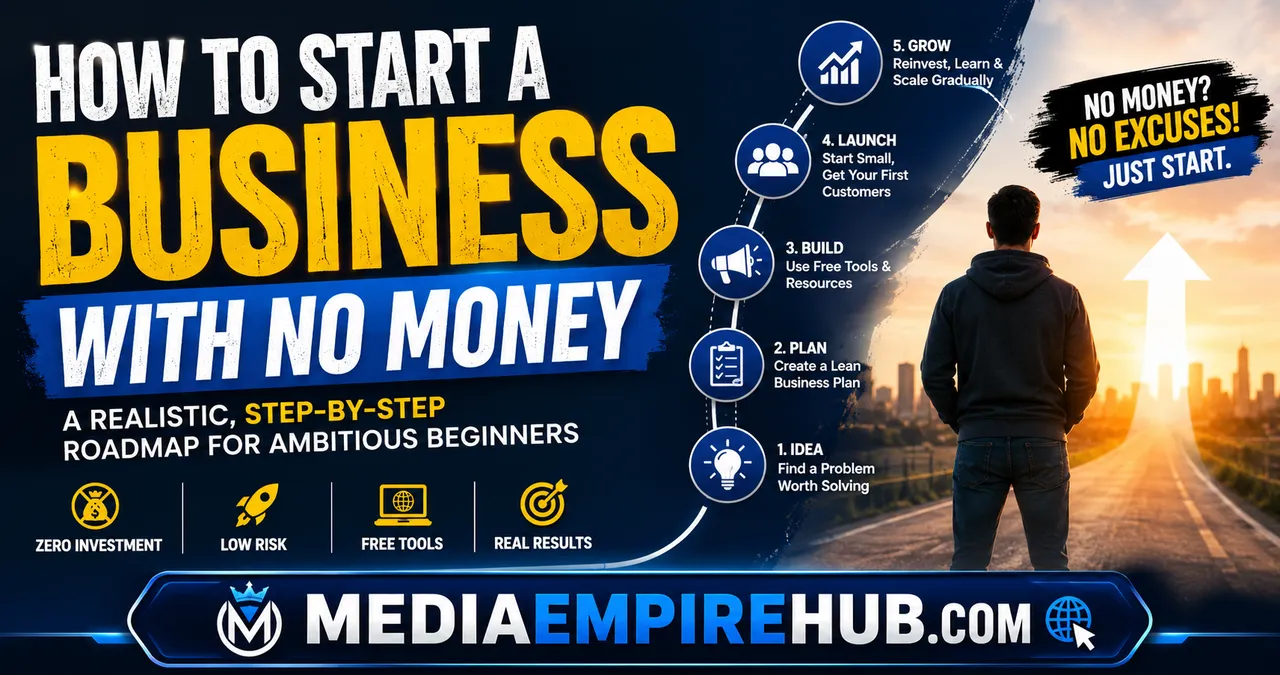
Most people assume that starting a company requires a fat bank account, a business loan, or at least a generous relative willing to invest. That belief stops more dreams than any recession ever has. The truth is far more encouraging: learning how to start a business with no money is not some clickbait fantasy, it’s a well-worn path that thousands of entrepreneurs have walked before you, often ending up more resourceful and resilient than founders who started with deep pockets.
This guide is not about vague motivational fluff. It’s a grounded, practical walkthrough of what actually works when your budget is essentially zero. You’ll learn how to pick the right kind of business, how to use your existing skills as currency, how to find your first customers without spending a rupee, dollar, or euro on ads, and how to grow steadily until you can reinvest real profit back into the business. Along the way, we’ll look at legal basics, common pitfalls, and even a comparison table to help you decide which no-money business model suits you best.
By the time you finish reading, you won’t just understand the theory behind how to start a business with no money, you’ll have an actionable plan you can begin executing today, using nothing but your time, your skills, and a bit of stubborn determination.
Why Lack of Capital Doesn’t Have to Stop You
It’s easy to feel like money is the missing ingredient that separates you from every successful founder you admire. But if you look closely at the origin stories of many well-known companies, you’ll notice a pattern. Sara Blakely famously started Spanx with just $5,000 in savings, cutting the feet off pantyhose in her apartment before she had a single investor. Companies like Apple and Amazon began in garages, not glass office towers. Capital helps, sure, but it has never been the deciding factor between success and failure.
What actually separates founders who make it from those who don’t is usually their ability to solve a real problem for real people, consistently, and their willingness to start messy rather than wait for perfect conditions. According to the U.S. Small Business Administration, a huge percentage of small businesses are started with personal savings under a few thousand dollars, not massive outside investment. That means the businesses succeeding around you right now were very likely bootstrapped, not bankrolled. Understanding this shifts the entire conversation. The real question isn’t whether you can start a business with no money, it’s whether you’re willing to trade time, creativity, and hustle for the capital you don’t have.
There’s also a hidden advantage to starting lean that many funded founders never get to experience. When you have no cushion, you’re forced to validate your idea quickly, talk to real customers early, and build only what people are actually willing to pay for. This lean approach, sometimes called bootstrapping, tends to produce businesses that are more resilient because they were built on actual demand rather than assumptions backed by investor money. So instead of viewing your empty bank account as a disadvantage, start viewing it as a forcing function that will make your business smarter from day one.
Shifting Your Mindset Before You Begin
Before we get into tactics, let’s talk about the mental shift required to genuinely pull this off. Most people who fail at building something from nothing don’t fail because of tactics, they fail because they never truly let go of the idea that they need money first. This belief becomes a comfortable excuse. It feels safer to say “I’ll start once I’ve saved up” than to admit that starting today, with what you have, is entirely possible but requires effort you’d rather not put in yet.
Successful bootstrapped founders adopt a scrappy, problem-solving mindset. Instead of asking “how much money do I need,” they ask “what do I already have that someone else would value.” That could be a skill, a spare room, a network of contacts, free time on weekends, or even just an internet connection and a willingness to learn. This reframing is the real starting point for anyone serious about how to start a business with no money, because it moves the conversation from what’s missing to what’s already available.
It also helps to accept that starting with no money often means starting small, slow, and a little unglamorous. Your first version of the business might be manual, unbranded, and run entirely from your phone. That’s normal. Nearly every scalable business began as an unscalable, scrappy operation. Jeff Bezos famously packed Amazon’s early orders on his knees on a concrete floor because the company couldn’t afford packing tables. The willingness to do unglamorous work in the early days is often what separates people who talk about entrepreneurship from those who actually build something.
Choosing a Business Idea That Requires Little to No Upfront Investment
Not every business idea is created equal when your budget is zero. Some models, like opening a restaurant or manufacturing a physical product, require significant capital for inventory, equipment, or rent. Others, particularly service-based and digital businesses, can be started with nothing more than your existing skills and a laptop or smartphone. If you’re serious about how to start a business with no money, your first job is to filter your ideas through this lens: does this require me to spend money before I earn any, or can I generate revenue first and reinvest it later?
Service-based businesses are usually the easiest entry point. Freelance writing, graphic design, virtual assistance, bookkeeping, social media management, tutoring, consulting, photography, and web development can all be started using skills you likely already have, with clients paying you directly for your time and expertise. However, if you want a complete roadmap on setting up legal structures, long-term funding, and marketing strategies, check out our comprehensive guide on how to start and launch a small business in 2026. There’s no inventory to buy, no warehouse to rent, and no product to manufacture. You are the product, and your knowledge is the inventory.
Another strong category is what’s often called an asset-light or platform-based business. Think of dropshipping using print-on-demand services, reselling items you already own, offering coaching through free video call tools, or creating digital products like templates, e-books, or online courses that cost nothing to duplicate once made. These models let you test an idea, get your first paying customer, and only then decide whether to invest more heavily. The key principle throughout is sequencing: earn before you spend, validate before you scale, and only take on costs once you have proof that people are willing to pay.
Using Skills and Services as Your Starting Capital
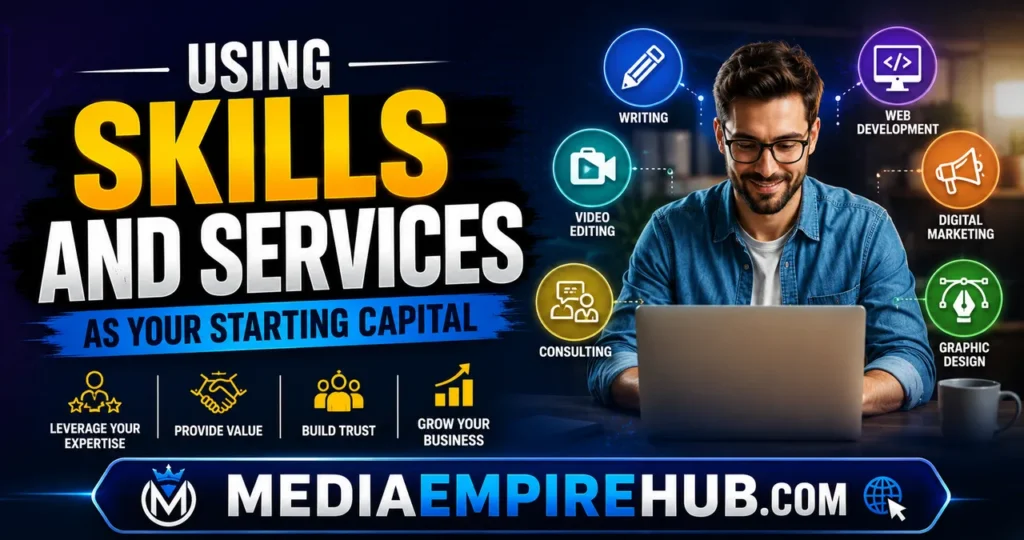
If you take away only one concept from this entire guide, let it be this: your skills are your capital when you have no money. Every hour you’ve spent learning something, whether it’s writing clearly, designing a logo, managing spreadsheets, speaking a second language, or fixing a leaking pipe, has value to someone who doesn’t have that skill and is willing to pay to skip the learning curve. This is the foundation of nearly every service business, and it’s the fastest legitimate path to earning your first dollar with zero investment.
Start by making an honest list of what you’re good at, even things that feel too obvious or too small to matter. Maybe you’re organized and detail-oriented, which makes you a natural virtual assistant. Maybe you’re comfortable with numbers, which opens the door to bookkeeping or tax preparation services. Maybe you’ve spent years managing your own social media and understand what makes content perform, which means small businesses would happily pay you to manage theirs. The goal isn’t to invent a brand-new skill overnight, it’s to package what you already know into something someone else will pay for.
Once you’ve identified your skill, the next step is finding your first client, even if it means charging less than you’re worth initially just to build a portfolio and testimonials. Platforms like Upwork, Fiverr, and LinkedIn make it possible to find paying clients without spending anything beyond your time creating a profile. As productivity expert Cal Newport has often pointed out in his writing on career capital, rare and valuable skills are what give you leverage in any market, and building that leverage doesn’t require capital, it requires deliberate practice and a willingness to put your work in front of people. This is precisely why the skills-first approach remains one of the most reliable answers to how to start a business with no money.
Leveraging Free and Low-Cost Digital Tools
One of the biggest advantages entrepreneurs have today that didn’t exist twenty years ago is the sheer volume of free tools available to run a legitimate business. You no longer need to buy expensive accounting software, hire a web developer, or pay for a graphic designer just to get started. Platforms like Canva offer professional-quality design templates for free, Google Workspace provides email, documents, and spreadsheets at no cost, and website builders likeWordPress.com or Wix have free tiers that let you establish an online presence before you’ve earned a single sale.
For communication and client management, tools like Zoom, WhatsApp Business, and Google Calendar allow you to run consultations, meetings, and scheduling without spending anything. Even accounting, which used to require hiring a bookkeeper, can be handled early on with free spreadsheet templates or free tiers of tools like Wave. The point is that the barrier to looking professional and operating efficiently has dropped dramatically, and anyone determined to figure out how to start a business with no money should be taking full advantage of this shift rather than assuming they need to pay for premium software from day one.
It’s worth mentioning that free tools do come with limitations, and that’s fine. Your goal in the early stage isn’t perfection, it’s functionality. A free website that loads properly and clearly explains what you offer is more valuable than a beautifully designed one you can’t afford yet. As your revenue grows, you can gradually upgrade to paid tools that offer more features, but there is no reason to spend money on premium subscriptions before you’ve validated that your business idea actually works. Treat every dollar of revenue as permission to slowly level up your toolkit, not as something to be spent recklessly on things that only make your business look nicer without making it more profitable.
Building a Brand Without Spending on Branding Agencies
A lot of new entrepreneurs assume that building a brand requires hiring a design agency or spending months developing a complex visual identity. That assumption keeps many good ideas stuck in someone’s notes app instead of out in the world. In reality, your brand in the early days is far less about polished visuals and far more about clarity, consistency, and trust. People don’t buy from you because your logo is perfect, they buy from you because they understand what you offer and believe you’ll deliver it well.
Start with the basics that cost nothing but time. Choose a clear business name that’s easy to say and spell. Write a simple, honest description of what you do and who you help, avoiding vague marketing jargon that confuses more than it clarifies. Use free design tools to create a simple logo and consistent color scheme you can apply across your social media profiles, invoices, and any materials you send to clients. Consistency, even a modest one, builds recognition faster than an expensive but inconsistent brand identity.
Your reputation, more than any visual branding element, is what will actually grow your business. Every client you serve well becomes a walking advertisement. Ask happy customers for reviews, testimonials, or referrals, and display these proudly wherever potential customers might see them. As Warren Buffett once put it, “It takes 20 years to build a reputation and five minutes to ruin it,” a line frequently cited by outlets like Forbes when discussing brand trust. That single idea should guide every interaction you have in the early days of your business, because when you’re figuring out how to start a business with no money, your reputation is often the only asset you truly control completely.
💡 Build Confidence Before Launching: Turn your zero-cost startup idea into a clear, actionable roadmap using our complete guide:
📖 How to Write a Simple Business Plan
Finding Your First Customers Without an Advertising Budget
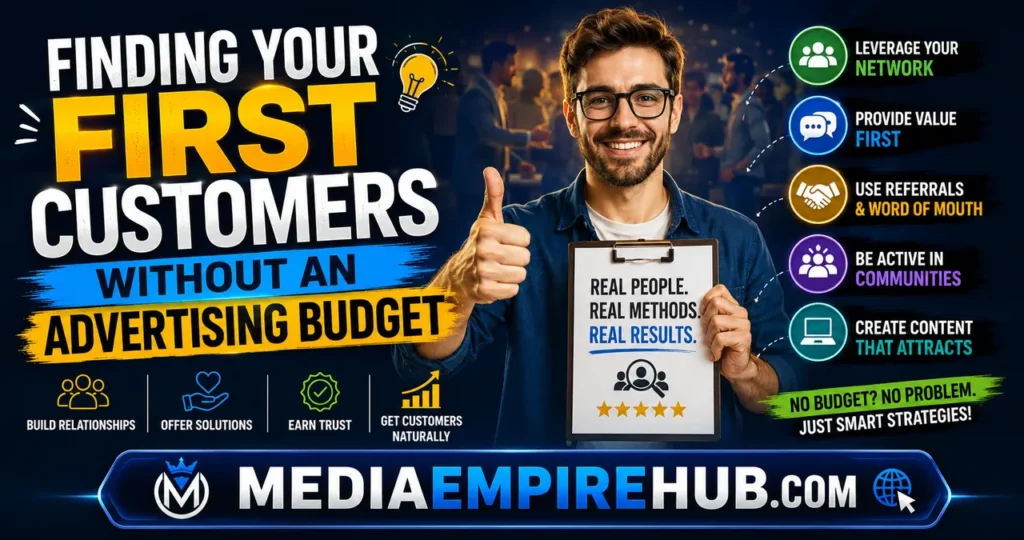
Getting your first customer without spending money on advertising feels intimidating, but it’s more achievable than most beginners expect. The key is understanding that paid advertising is just one method of reaching people, and it’s often the least effective method for brand-new businesses with no track record anyway. Instead, focus on channels that reward effort and relationship-building over ad spend.
Start with your existing network. Tell friends, family, former colleagues, and acquaintances exactly what you’re offering and ask them to spread the word or refer anyone who might need your service. This feels uncomfortable for a lot of people, but it’s one of the fastest ways to land your first few clients. Community groups, whether on Facebook, WhatsApp, Reddit, or local neighborhood forums, are another underused resource. Many of these groups actively welcome recommendations for local services, freelancers, or small businesses, and participating genuinely, rather than just dropping promotional links, tends to generate real leads.
Content creation is another powerful, free customer acquisition channel. Posting consistently on platforms like LinkedIn, Instagram, or TikTok about your area of expertise builds visibility and trust over time, especially if you focus on being genuinely helpful rather than overtly salesy. Cold outreach, done thoughtfully rather than spammy, also works surprisingly well; a personalized message to a potential client explaining specifically how you can help them solve a problem often gets a better response than any paid ad campaign. The common thread across all of these tactics is that they trade your time and effort for visibility, which is exactly the trade-off you should expect to make when you’re figuring out how to start a business with no money.
Bootstrapping Your Way to Growth
Bootstrapping simply means growing your business using its own revenue rather than external funding, and it’s the natural next phase once you’ve landed your first few paying customers. The discipline required here is resisting the urge to spend every dollar you earn on things that look impressive rather than things that actually move your business forward. Reinvestment should be strategic, not emotional.
A smart bootstrapping approach usually looks like this: use your early profits to remove your biggest bottleneck first. If you’re a freelance designer turning down work because you can’t keep up, invest in slightly better software to speed up your workflow. If you’re running a small online shop and packaging is eating up too much time, invest in tools that streamline that process. The idea is to reinvest in whatever constraint is actually limiting your growth, rather than spending on things that simply feel like what a “real business” should have, such as a fancy office or an oversized marketing budget before you’ve nailed your core offer.
Bootstrapped businesses also tend to prioritize profit margins over vanity metrics like follower counts or website traffic. It’s tempting to chase impressive-looking numbers, but revenue you can actually keep and reinvest is what fuels sustainable growth. As your team grows, keeping an eye on internal operations and company culture becomes equally essential to maintain high productivity. Basecamp co-founder Jason Fried has written extensively about this philosophy, arguing that businesses funded by their own customers tend to build more sustainable, focused products because every feature or service addition has to justify itself through actual paying demand rather than investor expectations.
Exploring Bartering, Partnerships, and Collaboration
When cash is scarce, trading value directly with other people or businesses can fill gaps that money would otherwise be needed for. Bartering is one of the oldest economic practices in human history, and it’s still remarkably useful for modern entrepreneurs. If you’re a web designer with no money for professional photography, you might trade a website build for a few hours of a local photographer’s time. If you run a small bakery from home, you might trade baked goods for help setting up your social media pages from someone skilled in marketing.
Partnerships work similarly but on a larger scale. Teaming up with someone whose skills complement yours can let you offer a more complete service without either of you having to hire staff or outsource for money. A copywriter and a graphic designer partnering together can offer full branding packages neither could deliver alone, splitting the revenue instead of splitting cash upfront. This kind of collaboration lets two resource-constrained individuals combine their strengths into something genuinely more valuable than either could produce solo.
Collaboration also extends to sharing audiences. If you know another entrepreneur whose audience overlaps with your target customers, proposing a joint promotion, guest content swap, or referral arrangement can expose your business to new potential clients without spending a cent on advertising. Leveraging these kinds of business leverage strategies and mutually beneficial relationships is one of the most underrated tools available to anyone determined to figure out how to start a business with no money, because they multiply your resources without requiring either party to open their wallet.
Understanding Free and Low-Cost Funding Options
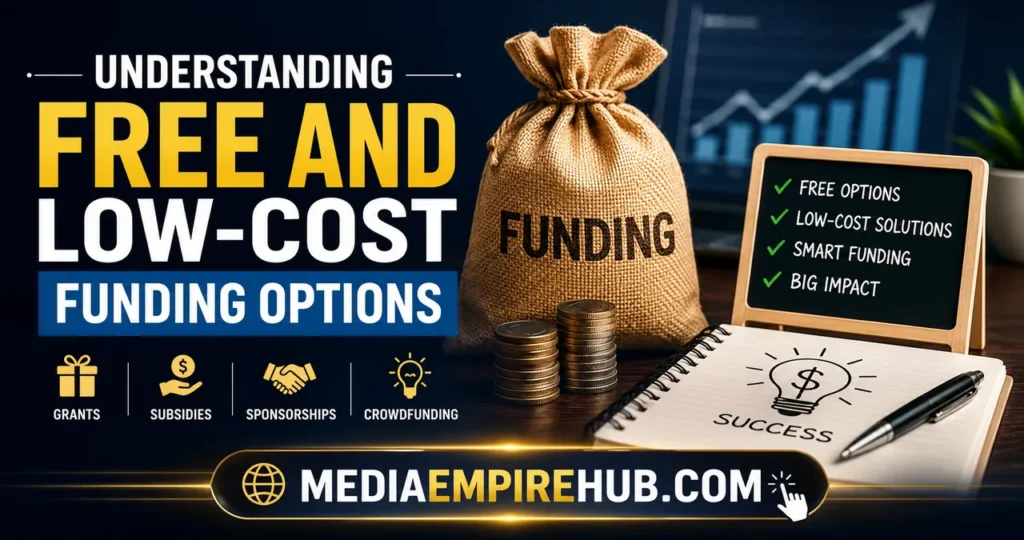
Even though this guide focuses heavily on starting without capital, it’s worth understanding the legitimate low-cost or no-cost funding avenues that exist once you’re ready to scale slightly beyond bootstrapping. Government-backed resources are often overlooked by new entrepreneurs. In the United States, organizations like SCORE offer free mentorship from experienced business professionals, and the U.S. Small Business Administration provides free planning tools, guides, and occasionally connects entrepreneurs to microloan programs with far more favorable terms than traditional bank loans.
Grants, though competitive, are another option worth researching, particularly for businesses owned by women, minorities, veterans, or those operating in specific industries like sustainability or technology. Unlike loans, grants don’t need to be repaid, though they typically require a more detailed application and sometimes a track record of at least some initial traction. Crowdfunding platforms such as Kickstarter or Indiegogo also allow entrepreneurs to raise money based on pre-sales of a product concept, essentially letting future customers fund the initial production run in exchange for early access or rewards.
It’s important to approach all funding options with realistic expectations. Grants and crowdfunding require significant preparation and rarely produce quick results, and loans, even favorable ones, still involve repayment obligations that a brand-new, unproven business might struggle to meet. This is why the core strategy in this guide emphasizes starting with your own effort and skills first. Once you’ve proven that your idea generates real revenue, you become a far more attractive candidate for any of these funding routes, and you’ll also have a much clearer sense of exactly how much capital you actually need rather than guessing.
Comparing No-Money Business Models at a Glance
Choosing the right starting point matters enormously when you have no money to fall back on if you guess wrong. The table below compares some of the most accessible business models for anyone exploring how to start a business with no money, based on startup cost, time to first sale, and scalability potential.
| Business Model | Typical Startup Cost | Time to First Sale | Scalability | Core Requirement |
| Freelance writing or design | $0 to $20 | Days to weeks | Moderate | Existing skill and a portfolio |
| Virtual assistant services | $0 | Days to weeks | Moderate | Organization and communication skills |
| Social media management | $0 to $30 | Weeks | High | Marketing knowledge, consistency |
| Dropshipping or print-on-demand | $0 to $50 | Weeks | High | Product research, basic marketing |
| Online tutoring or coaching | $0 | Days | Moderate to high | Subject expertise, communication |
| Reselling secondhand items | $0 | Days | Low to moderate | Sourcing skill, negotiation |
| Local service business (cleaning, gardening, errands) | $0 to $50 | Days | Low to moderate | Physical labor, reliability |
| Digital products (templates, e-books) | $0 | Weeks to months | High | Content creation, initial audience |
This table isn’t exhaustive, but it illustrates an important truth: nearly every low-cost model trades one resource for another. Where you can’t spend money, you’ll spend time, effort, or existing skill instead. Understanding this trade-off helps you choose a starting point that matches your strengths rather than picking something simply because it sounds trendy or because someone else made it look easy online.
Legal Basics You Shouldn’t Skip Even on a Zero Budget
It’s tempting to skip legal and administrative steps entirely when you’re just trying to get your first client, but a few basic protections are worth setting up early, and most of them cost little to nothing. In most countries, operating as a sole proprietor requires no formal registration at all to begin working and invoicing clients, though it does mean your personal assets aren’t legally separated from your business. As your revenue grows, forming a simple limited liability structure becomes more important to protect your personal finances from any business-related liability.
Keeping accurate financial records from day one, even in a free spreadsheet, will save you enormous headaches later, especially around tax season. Track every payment received and every expense, no matter how small, because these records will determine what you owe in taxes and can also help you spot which parts of your business are actually profitable. Resources like Investopedia offer accessible explanations of business structures and tax basics that are worth a quick read before you start invoicing clients seriously.
Contracts are another area new entrepreneurs neglect, assuming they’re only necessary for big, established companies. Even a simple one-page agreement outlining what you’ll deliver, when, and for how much protects both you and your client from misunderstandings. Free contract templates are widely available online, and using one, even informally, signals professionalism to clients and protects you if a dispute ever arises. None of these legal basics require significant money, but skipping them entirely can create expensive problems down the road, which somewhat defeats the purpose of starting lean in the first place.
Common Mistakes to Avoid When Starting With No Money
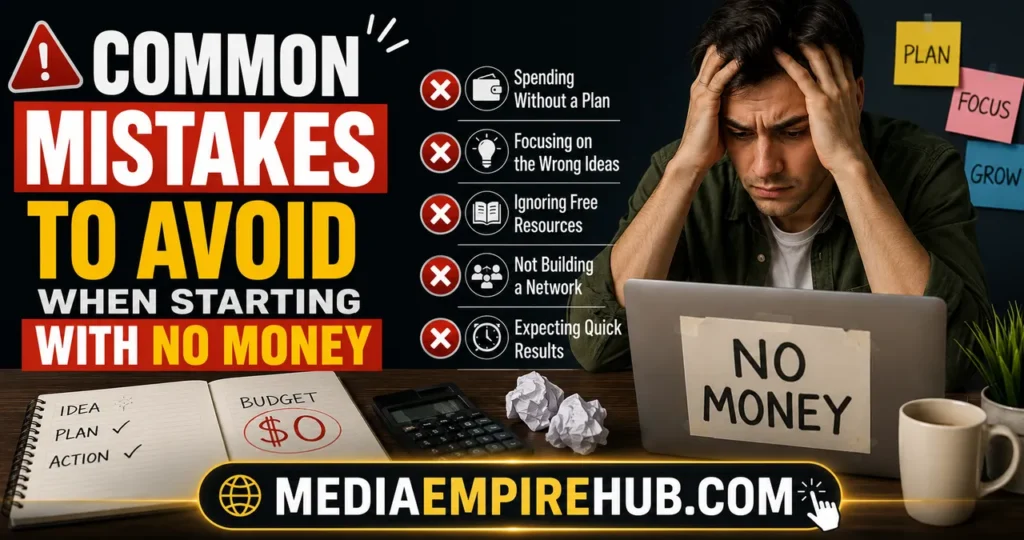
One of the most common mistakes new entrepreneurs make is trying to look bigger than they actually are before they’ve earned the right to. Spending your first hundred dollars on business cards, a fancy website, or branded merchandise before you’ve landed a single client is a classic trap. Money spent on appearances rather than actual customer acquisition or product improvement rarely pays for itself in the early stage, and it depletes the very limited resources you’re trying to stretch as far as possible.
Another frequent mistake is underpricing so aggressively that the business becomes unsustainable even when it’s technically busy. Many beginners, eager for their first sale, price their services far below what their time is worth, and then find themselves overwhelmed with work that barely covers their basic expenses. It’s fine to offer an introductory rate to build a portfolio, but you should have a clear plan to raise your prices as soon as you’ve gathered enough testimonials and experience to justify charging what you’re actually worth.
A third mistake worth flagging is waiting for perfect conditions before launching. Entrepreneurs frequently delay starting because they’re still refining a logo, still tweaking a website, or still waiting to feel fully confident. This perfectionism is often just fear wearing a productive disguise. As the saying popularized by LinkedIn co-founder Reid Hoffman goes, “If you are not embarrassed by the first version of your product, you’ve launched too late.” Anyone genuinely committed to how to start a business with no money needs to embrace an imperfect, scrappy launch rather than waiting for conditions that, realistically, may never feel fully ready.
Real Stories That Prove It’s Possible
It helps to remember that the path from nothing to something has been walked successfully by real people, not just theoretical case studies in a business textbook. Sara Blakely built Spanx into a billion-dollar company starting with $5,000 in personal savings and a homemade prototype, going door to door pitching department store buyers herself before she could afford a sales team. Her story is frequently cited precisely because it demonstrates that grit and creative problem-solving can outweigh a lack of starting capital.
Airbnb’s founders famously funded their early operations by selling novelty cereal boxes during a political convention because they couldn’t secure traditional funding at first, a scrappy, almost desperate move that kept the company alive long enough to eventually prove its business model. These aren’t isolated exceptions; they’re representative of a much larger pattern among successful founders, many of whom describe their early resourcefulness as one of the most valuable skills they developed, one that continued to shape decision-making even after the company had plenty of capital.
As entrepreneur and author Chris Guillebeau writes in his work on unconventional business building, “You don’t need a lot of money to start a business you love, you need a problem worth solving and the willingness to start before you feel ready.” That sentiment captures the essence of everything covered in this guide. The businesses that last aren’t necessarily the ones that started with the most funding, they’re the ones built by founders willing to solve real problems with whatever resources they had on hand, refining and reinvesting as they went.
Scaling Up Once You Have Some Revenue
Once your no-money business starts generating consistent income, the temptation to scale quickly can be strong, but disciplined scaling matters just as much as disciplined starting. Before reinvesting heavily, take time to understand exactly which parts of your business are generating the most profit and which are consuming time without proportional return. This clarity prevents you from scaling activities that feel productive but aren’t actually driving your bottom line.
Consider gradually outsourcing tasks that don’t require your specific expertise once you have the revenue to support it, freeing up your time to focus on higher-value work like landing bigger clients or developing new revenue streams. This lean operational model works for almost any industry—whether you run a digital agency or operate as a solo professional, learning the art of scaling without hiring full-time staff allows you to grow exponentially with minimal risk. This might mean hiring a virtual assistant for administrative tasks, bringing on a subcontractor for overflow client work, or investing in slightly more capable tools that save you hours each week.
It’s also worth revisiting your pricing structure as you scale. Many founders who started with no money keep their original, discounted pricing far longer than they should out of habit or fear of losing clients. As your skills, reputation, and demand grow, gradually increasing your rates isn’t greedy, it’s a natural and necessary part of building a sustainable business rather than simply staying busy. The businesses that transition successfully from a no-money starting point to a genuinely thriving company are almost always the ones that treat growth as a deliberate, measured process rather than a race to spend every available dollar as quickly as it comes in.
📖 Next Step: Once you have generated initial cash flow with zero startup costs, discover high-margin options to reinvest and scale:
🚀 Low Investment Business Ideas With High Profit
Staying Motivated When Progress Feels Slow
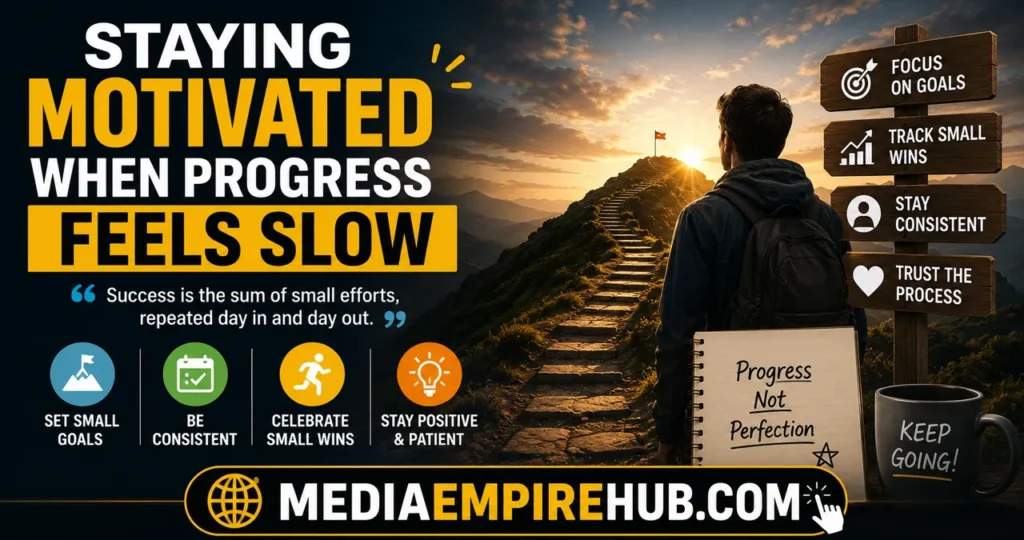
Building something from nothing rarely follows a straight, encouraging upward line. There will be weeks where nothing seems to work, clients go quiet, and doubt creeps in about whether this whole venture was a mistake. This is completely normal, and nearly every successful entrepreneur has weathered stretches exactly like this. The difference between those who eventually succeed and those who quit often comes down to their ability to keep showing up consistently even when results aren’t immediately visible.
One practical way to sustain motivation is tracking small wins alongside big goals. Landing your first client, receiving your first testimonial, hitting your first hundred dollars in revenue, these milestones matter far more than they might initially seem, because they provide concrete evidence that your idea has real-world validity. Celebrating these small victories, even quietly to yourself, helps reinforce the belief that consistent effort is paying off, which makes it easier to push through the inevitable slow periods that follow.
It’s also worth connecting with other entrepreneurs going through similar challenges, whether through online communities, local small business meetups, or simply staying in touch with people who understand the specific pressures of building something with limited resources. Isolation tends to amplify doubt, while community tends to normalize struggle and remind you that setbacks are part of the process rather than evidence that you’re failing. Anyone seriously exploring how to start a business with no money should expect this emotional dimension to be just as real as the practical tactics, and preparing for it mentally makes the entire journey considerably more manageable.
Starting a business with genuinely no money is not the impossible fantasy it sometimes gets portrayed as, nor is it an easy shortcut around hard work. It’s a realistic, well-documented path that requires you to lean heavily on your existing skills, your resourcefulness, and your willingness to trade time and effort for the capital you don’t yet have. From choosing a low-cost business model that matches your strengths, to using free tools, to finding your first customers through relationships rather than advertising budgets, every strategy covered in this guide has been used successfully by real entrepreneurs who started exactly where you might be starting today. The businesses that thrive long-term are rarely the ones with the biggest initial checkbook, they’re the ones built by founders who understood how to solve real problems for real people and reinvested wisely as revenue started to flow in. If you take one thing away from everything covered here, let it be this: the absence of money is not the absence of opportunity, and understanding how to start a business with no money simply means understanding how to start with what you actually have.
📜 Official Setup: Ready to formalize your setup? Learn how to get your EIN, licenses, and official filings in order:
👉 How to Register a Small Business Step-by-Step
Frequently Asked Questions
Is it really possible to start a business with absolutely no money?
Yes, it’s genuinely possible, particularly with service-based or digital businesses that rely on your existing skills rather than physical inventory or equipment. Freelancing, consulting, virtual assistance, and content-based businesses can all be started using free tools and platforms, with your time and expertise serving as the primary investment rather than cash. Many well-known companies began this way, using personal savings under a few thousand dollars or, in some documented cases, essentially nothing beyond the founder’s own labor and creativity.
What is the fastest way to start earning money without any startup capital?
Offering a service based on a skill you already have is typically the fastest route, since it requires no product development, inventory, or manufacturing time. Freelance writing, graphic design, tutoring, and virtual assistant work can all generate your first payment within days if you actively reach out to your network and relevant online platforms. The key is starting to offer your service publicly rather than waiting until you feel fully prepared, since real client feedback teaches you more than additional preparation ever will.
How do I get customers if I can’t afford to advertise?
Focus on your existing network, community groups, content creation, and direct, personalized outreach rather than paid advertising. Telling friends and former colleagues exactly what you offer, participating genuinely in relevant online communities, and posting consistently about your expertise on platforms like LinkedIn or Instagram all build visibility without requiring any advertising spend. Word-of-mouth referrals from satisfied early clients also become one of your strongest and most cost-effective growth channels over time.
Do I need to register my business immediately if I’m starting with no money?
In most countries, you can legally begin working as a sole proprietor without formal registration, which means you can start earning money and testing your idea before dealing with formal business structures. However, once you’re generating consistent income, forming a simple legal structure like a limited liability company becomes important to protect your personal assets from business-related liability. Keeping accurate financial records from the very beginning, even in a free spreadsheet, will make this transition much smoother when the time comes.
What are the biggest mistakes people make when trying to start a business with no money?
The most common mistakes include spending limited resources on appearances like fancy branding or business cards before landing any customers, underpricing services so aggressively that the business becomes unsustainable, and waiting for perfect conditions instead of launching an imperfect first version. Successful bootstrapped founders generally prioritize customer acquisition and reinvestment in real growth bottlenecks over anything that simply makes the business look more impressive without generating actual revenue. Avoiding these mistakes early significantly increases the odds that a no-money business survives long enough to become genuinely profitable.
How long does it typically take to see real profit when starting with no money?
This varies widely depending on the business model, but service-based businesses often generate their first payment within days or weeks, since they don’t require product development or inventory. Building consistent, meaningful profit usually takes several months of steady effort, reinvestment, and refinement based on client feedback. Patience and consistency matter more than speed in the early stages, since businesses built on real validated demand tend to be far more durable than those that scale quickly without a solid foundation.
Related Guide: Read our step-by-step guide on How to Start and Launch a Small Business in 2026.