

Starting a company used to mean drowning in loans, leases, and years of red ink before you saw a single dollar back. That world is mostly gone. Today, some of the most successful entrepreneurs on the planet started with little more than a laptop, a phone, and a stubborn refusal to quit. If you have been searching for low investment business ideas with high profit, you are in good company, because more people than ever are choosing to skip the corporate ladder and build something of their own instead.
This guide is not another recycled list of “top ten side hustles” that vanishes into vague generalities the moment you ask how to actually get started. Instead, we are going to walk through real, workable paths that ordinary people are using right now to generate serious income without draining their savings account. Some of these ideas require a few hundred dollars to launch. Others need almost nothing beyond your time and a willingness to learn. What they all share is a favorable ratio between what you put in and what you can realistically get out, which is exactly what makes them worth your attention.
By the time you finish reading, you will understand not just which businesses tend to be the most profitable relative to their startup cost, but also how to choose the one that fits your skills, your schedule, and your risk tolerance. We will also cover the mistakes that quietly sink new entrepreneurs, how to market a business on a shoestring budget, and how to think about scaling once the money starts coming in. Consider this your roadmap from curiosity to a functioning, income-generating venture.
🚀 Complete 2026 Launch Guide: If you are looking for a complete step-by-step roadmap to start, structure, and launch your venture this year, check out our master resource:
👉 How to Start and Launch a Small Business in 2026
Why Low Investment Business Ideas With High Profit Are Having a Moment Right Now
The economic landscape has shifted dramatically over the last decade, and that shift favors the small, nimble entrepreneur over the heavily capitalized corporation. Cloud computing, free marketing platforms, and on-demand manufacturing have collectively torn down the barriers that once made starting a business a rich person’s game. A single person with a smartphone can now reach millions of potential customers without spending a cent on advertising, something that was simply unimaginable a generation ago.
There is also a cultural shift happening alongside the technological one. People are less interested in a single employer for thirty years and more interested in building multiple income streams that give them flexibility and control. According to reporting from Forbes, small business formation in the United States has remained remarkably resilient even through periods of economic uncertainty, driven largely by people launching lean, low-cost ventures rather than capital-heavy enterprises. That trend is not a coincidence. It reflects a growing understanding that you do not need a warehouse full of inventory or a storefront on Main Street to build something profitable.
What makes this moment particularly interesting is the sheer variety of paths available. You could sell digital templates from your bedroom, offer consulting calls from a coffee shop, or run a niche e-commerce store entirely from your phone. The common denominator across all of these paths is a low barrier to entry paired with a genuinely attractive margin once the business finds its footing. That combination is precisely why so many people are actively searching for low investment business ideas with high profit rather than traditional franchise opportunities that demand six-figure buy-ins.
None of this means these businesses are effortless. Every one of them still requires strategy, consistency, and a willingness to learn from mistakes. But the financial risk is dramatically lower than it used to be, which means the psychological barrier to simply trying something has also dropped. That is a genuinely good thing for anyone who has been sitting on an idea, waiting for the “right time” to finally start.
What Actually Makes a Business Idea Both Low Investment and High Profit
Before diving into specific ideas, it helps to understand the underlying mechanics that separate a genuinely profitable low-cost business from one that just looks appealing on paper. The first factor is overhead. A business with minimal recurring costs, such as rent, staff salaries, or expensive equipment, keeps more of every dollar it earns. This is why service-based and digital businesses tend to dominate lists of low investment business ideas with high profit; there is simply less standing between the sale and the money hitting your bank account.
The second factor is scalability. A business that can serve one more customer without a proportional increase in cost has a structural advantage. Selling a downloadable course to your one-thousandth customer costs almost nothing extra, whereas a business that requires you to personally show up for every transaction has a natural ceiling. That is not to say service businesses cannot be profitable; many are wonderfully so. But understanding where your particular idea sits on the scalability spectrum will shape how you plan for growth later.
Margin matters just as much as revenue. A business that brings in ten thousand dollars a month but spends nine thousand on materials, shipping, and fees is in a fundamentally different position than one that brings in five thousand dollars and keeps four thousand of it. When evaluating any opportunity, always ask what percentage of each sale you actually get to keep after every cost is accounted for. This single question will save you from chasing shiny but ultimately unprofitable ventures.
Finally, consider demand durability. Trends come and go, and a business built entirely around a fleeting fad can collapse just as quickly as it rose. The most resilient budget-friendly, high-margin ventures tend to solve an ongoing problem or serve a need that is not going away anytime soon, whether that is people wanting to learn new skills, needing help with their finances, or simply wanting products that make their lives a little easier. Building around durable demand gives your business staying power well beyond its first exciting weeks.
Online Reselling and Dropshipping Ventures Worth Considering
Reselling has existed for as long as commerce itself, but the internet has turned it into one of the most accessible entry points for new entrepreneurs. With dropshipping, you list products for sale without ever holding inventory yourself; when a customer orders, your supplier ships the item directly to them, and you keep the difference between your selling price and the wholesale cost. This model dramatically reduces upfront risk because you are never sitting on unsold stock.
The trade-off is that margins on generic dropshipped products can be thin, and competition in popular categories is fierce. The entrepreneurs who genuinely thrive in this space tend to niche down hard, focusing on a specific type of customer rather than trying to sell everything to everyone. A store built entirely around gear for new dog owners, for example, can command loyalty and repeat business in a way that a generic “everything store” simply cannot. Choosing a defensible niche is often the difference between a store that fizzles out and one that becomes a genuinely profitable long-term asset.
Reselling secondhand goods is a related but distinct path that deserves more attention than it usually gets. Thrifting for undervalued clothing, collectibles, or electronics and reselling them on platforms built for resale can produce impressive margins because your cost basis is often a fraction of the resale value. This approach does require more hands-on time than dropshipping, since you are physically sourcing and often reselling and shipping items yourself, but the profit margins tend to be considerably healthier as a result.
Whichever version you choose, success in this category comes down to product research, pricing discipline, and customer service. Sellers who treat returns, shipping delays, and customer questions professionally build the kind of reputation that turns one-time buyers into repeat customers. That repeat business, more than any single viral sale, is usually what separates a hobby from a genuinely sustainable venture in this space.
Digital Products and Online Courses That Sell While You Sleep

If you had to pick one category that best represents the modern version of low investment business ideas with high profit, digital products would be a strong candidate. Once you create a template, an ebook, a printable planner, or a video course, you can sell that same asset an unlimited number of times without ever manufacturing another unit. There is no shipping, no inventory, and no manufacturing cost eating into your margin after the initial creation work is done.
The startup cost here is almost entirely your time and expertise rather than your money. If you have a skill that other people are willing to pay to learn, whether that is graphic design, personal finance, cooking, or even a niche hobby like calligraphy, you can package that knowledge into a course or downloadable resource. Platforms built specifically for creators handle the payment processing and delivery, meaning you can be up and running within days rather than months.
What separates a successful digital product business from one that never gains traction is usually not the quality of the product itself but the clarity of the audience it serves. A course titled simply “Learn Photography” competes against thousands of similar generic offerings, while a course titled “Smartphone Photography for Real Estate Agents Who Cannot Afford a Photographer” speaks directly to a specific, motivated buyer. Specificity sells because it signals to the right person that this resource was built for them exactly.
Pricing digital products correctly is its own skill worth developing. Many first-time creators underprice their work out of nervousness, which ironically can make a product look less credible rather than more accessible. A well-positioned digital product priced appropriately for the transformation it delivers will consistently outperform a cheap one that customers perceive as low value. As one independent course creator put it in an interview about her six-figure online education business, “People do not buy the cheapest option, they buy the option that feels like the safest bet for solving their actual problem.”
💡 Related Reading: Have zero startup capital to begin with? Learn how to take your first step with absolutely no initial investment:
📖 How to Start a Business with No Money
Freelance Services You Can Start With Nothing More Than a Laptop
Freelancing remains one of the fastest ways to generate income with essentially zero startup capital, which is exactly why it belongs near the top of any serious discussion of affordable, highly profitable startup options. Writing, graphic design, video editing, web development, virtual bookkeeping, and social media management are all services that businesses of every size are actively paying for right now. If you already have a marketable skill, you can realistically start earning within your first week.
The beauty of freelancing is that your only real cost is the software you use to do the work, much of which has generous free tiers for beginners. There is no inventory to purchase, no shipping to manage, and no physical location required. Every dollar a client pays you, minus whatever platform fee you might incur, goes directly into your pocket. Few other business models offer that kind of immediate, uncomplicated profitability.
The challenge most new freelancers face is not a lack of skill but a lack of positioning. Freelancers who market themselves as generalists willing to do “anything” tend to struggle to command strong rates, because clients cannot tell what makes them different from the next generalist. Specializing, even within an already-narrow field, tends to produce dramatically better results. A freelance writer who focuses exclusively on writing for dental practices, for instance, can charge premium rates because dentists trust that this writer already understands their industry.
Building a freelance business into something more than occasional gig work also requires treating it like a real business from day one, complete with contracts, clear deliverables, and consistent invoicing. Freelancers who take this seriously from the start tend to raise their rates faster and retain better clients than those who treat the work casually. Over time, many successful freelancers transition into running small agencies, hiring other freelancers to handle overflow work, which turns a personal service into something with genuine scalability.
Content Creation and Personal Branding as a Genuine Business Model
Content creation has evolved well past the point of being a hobby for a lucky few influencers. Today it is a legitimate, structured business model built on multiple, often overlapping revenue streams including brand partnerships, affiliate commissions, digital product sales, and platform payouts. Someone with a smartphone and consistent posting habits can realistically build an audience and monetize it without spending anything beyond their own time and creativity.
What makes this category particularly appealing among low-cost, high-return ventures is the compounding nature of an audience. Every piece of content you publish has the potential to keep working for you long after you hit publish, continuing to attract new followers, subscribers, and customers months or even years later. Unlike a one-off service transaction, a well-performing piece of content becomes a durable asset that keeps generating value over time.
That said, this path rewards patience more than almost any other on this list. Building a genuinely engaged audience typically takes consistent effort over many months before meaningful income appears, and the algorithms governing distribution can be unpredictable. Creators who succeed tend to treat content creation less like a lottery ticket and more like a long-term skill-building exercise, refining their voice, their niche, and their production quality with every upload.
Diversifying income streams within a content business also matters enormously for long-term stability. Relying solely on platform ad revenue leaves you vulnerable to algorithm changes and payout fluctuations outside your control. Creators who layer in their own digital products, affiliate partnerships, and even paid membership communities tend to weather platform volatility far better than those depending on a single income source. As one growth strategist commonly advises new creators, “Never let a platform you do not own become your entire business.”
Home-Based Food and Baking Businesses With Loyal Local Followings
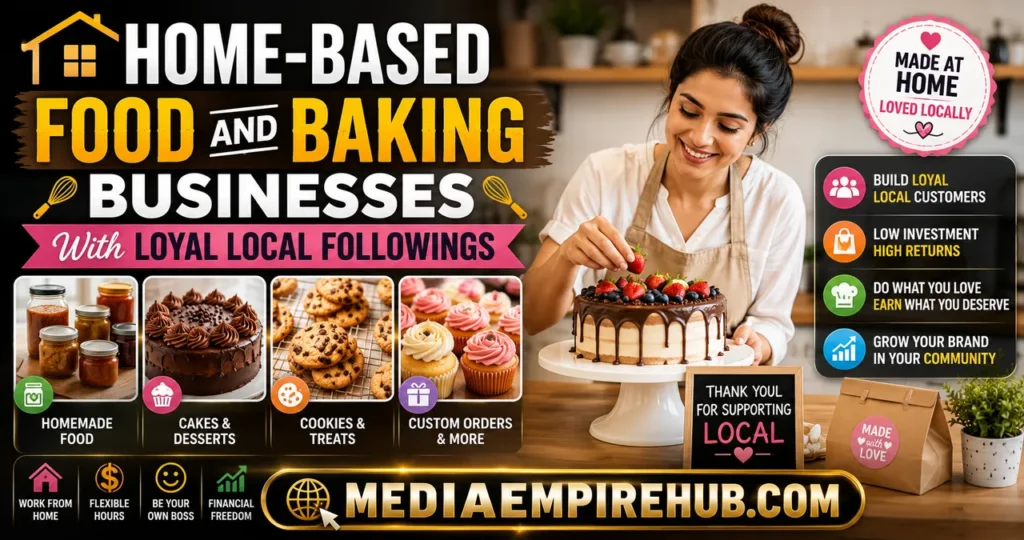
Food-based businesses occupy an interesting middle ground within the world of small-budget, high-margin businesses because they require a bit more upfront setup than a purely digital business but still cost dramatically less than opening a restaurant. Cottage food laws in many regions now allow individuals to legally bake and sell certain foods from their home kitchens without the enormous overhead of a commercial kitchen lease, provided they follow local licensing and labeling requirements.
The ingredient cost for most baked goods is remarkably low relative to what customers are willing to pay, particularly for specialty items like custom cakes, allergen-friendly treats, or culturally specific recipes that are hard to find elsewhere. A homemade cake that costs perhaps fifteen dollars in ingredients can easily sell for eighty or more when it is custom-designed for a birthday or wedding, which produces a margin that is difficult to match in most physical product businesses.
Local demand also tends to be more forgiving of a slow, organic start than online-only businesses. Word of mouth within a neighborhood, school community, or local social media group can generate a steady stream of orders without any paid advertising at all. Many successful home bakers built their entire customer base initially through friends, family, and community recommendations before ever running a single ad.
The keys to sustainable profitability in this space are consistency, presentation, and pricing confidence. New bakers often undercharge dramatically out of fear that no one will pay a fair price, which quickly leads to burnout when the math simply does not work. Building a pricing structure that properly accounts for your time, not just your ingredients, is essential to turning a beloved hobby into an actual profitable enterprise rather than an expensive labor of love.
Local Service Businesses That Run on Almost No Overhead
Not every profitable business needs to live online. Local service businesses such as house cleaning, pet sitting, lawn care, mobile car detailing, and handyman work remain some of the most reliably profitable low investment business ideas with high profit precisely because the barrier to entry is so low and demand is constant. Most of these businesses can be started with little more than basic tools you may already own and a way for customers to reach you.
The economics of local service work are genuinely favorable once you account for the numbers honestly. A mobile car detailer, for example, might spend twenty or thirty dollars in supplies for a job that earns them a hundred and fifty dollars or more, and that ratio only improves as they build efficiency and repeat clientele. Because there is no product being manufactured or shipped, almost the entire fee beyond basic supplies becomes profit that goes straight into your pocket.
Trust and reputation matter enormously in local service businesses, arguably more than in any online venture. Because customers are inviting you into their homes or trusting you with their property, reviews and referrals carry outsized weight. Building a strong reputation early, even if it means doing your first several jobs at a discounted rate to accumulate glowing testimonials, pays enormous dividends once word starts spreading through a neighborhood or local community group.
Scaling a local service business often looks different than scaling an online one. Rather than growing infinitely through content or advertising, growth tends to come from hiring additional workers to handle more jobs simultaneously, or from expanding into adjacent services that your existing customer base already trusts you to provide. A cleaning business, for instance, might naturally expand into organizing services or move-out cleaning packages, deepening its relationship with existing customers rather than constantly chasing new ones.
🛠️ Next Step — Legalization: Once you choose your business idea, ensure your venture is fully compliant and protected by following our step-by-step walkthrough:
📖 How to Register a Small Business Without the Stress
Print on Demand and Custom Merchandise Without Holding Inventory
Print on demand has become a favorite entry point for creative entrepreneurs precisely because it eliminates one of the biggest traditional risks of physical product businesses: unsold inventory. You design a shirt, mug, or piece of wall art, upload it to a print-on-demand platform, and the item is only manufactured after a customer actually purchases it. There is no warehouse, no upfront bulk order, and no risk of being stuck with boxes of unsold merchandise.
This model fits neatly within the category of low-cost ventures with strong profit margins because your only real cost is the time spent designing and marketing your products. Platforms handle production and shipping automatically, meaning a single person can run a print-on-demand store as a side project without ever touching a physical product themselves. Margins per item tend to be modest compared to bulk manufacturing, but the complete absence of upfront inventory risk more than makes up for it for most beginners.
Success in this space, much like in dropshipping, hinges heavily on niche selection and design quality. Generic, uninspired designs compete in an oversaturated market and rarely gain traction. Designs built around a specific community, inside joke, profession, or passionate hobby group tend to perform dramatically better because they speak directly to people who feel genuinely seen by the product rather than marketed at.
Building a brand identity around your print-on-demand store, rather than treating it as a disconnected collection of random designs, also significantly improves long-term profitability. Customers are far more likely to return for a second purchase, and recommend the store to friends, when the products feel like they come from a cohesive, intentional brand rather than a random assortment thrown together for quick sales. That brand consistency is often what elevates a hobby store into a genuinely profitable small business.
Affiliate Marketing and Niche Content Websites

Affiliate marketing works on a wonderfully simple premise: you recommend products or services you genuinely believe in, and you earn a commission whenever someone makes a purchase through your unique link. Because you never handle the product, customer service, or fulfillment yourself, the overhead is close to nonexistent, which is exactly why this model shows up so consistently in conversations about affordable ventures with excellent earning potential.
The most durable affiliate businesses tend to be built around a niche content website or a highly focused social media presence rather than scattered, random recommendations. A website dedicated entirely to reviewing home coffee equipment, for example, can build genuine authority and trust with readers over time, which translates into consistently higher conversion rates than a generic blog covering dozens of unrelated topics. Search engines and readers alike tend to reward focused expertise over scattered generalism.
Patience is genuinely required here, perhaps more than in any other model on this list. Building organic search traffic or a loyal social following takes sustained effort over months, and affiliate income in the early stages can feel discouragingly small. However, once a niche site or channel gains traction, the income it produces can become remarkably passive, requiring only periodic updates rather than constant new content to maintain earnings.
Trustworthiness is the currency that makes or breaks an affiliate business over the long run. Audiences quickly grow skeptical of creators who seem to recommend everything indiscriminately purely for a commission. The most successful affiliate marketers are transparent about their partnerships and genuinely selective about what they promote, which paradoxically tends to increase conversions because their audience trusts that any recommendation reflects real, considered judgment rather than blanket promotion.
Social Media Management and Virtual Assistance for Small Businesses
Countless small business owners understand that they need a consistent social media presence but simply do not have the time, interest, or skill to manage it themselves. This gap has created enormous demand for social media managers and virtual assistants who can handle scheduling, content creation, and basic customer engagement on a business owner’s behalf. It is one of the more straightforward low-cost, high-return business paths because it requires essentially no equipment beyond what you already own.
Virtual assistance more broadly covers an even wider range of tasks, including email management, appointment scheduling, basic bookkeeping, and customer support. Many small business owners would rather pay someone a reasonable monthly retainer to handle these tasks than hire a full-time employee with all the associated payroll taxes, benefits, and overhead. This creates a genuinely favorable arrangement for the virtual assistant, who can often serve multiple clients simultaneously and build a stable, recurring income stream.
The path to strong profitability in this field usually involves moving away from hourly billing and toward package-based or retainer pricing as quickly as possible. Hourly billing inherently caps your income at the number of hours in a day, whereas a retainer arrangement rewards you for efficiency and results rather than time spent. A virtual assistant who can complete a client’s monthly needs in fifteen hours but bills a flat retainer equivalent to twenty-five hours of work is effectively earning a premium for their competence.
Building a roster of clients in this space also benefits enormously from specialization. A virtual assistant who exclusively serves real estate agents, for instance, can develop deep familiarity with the specific tools, terminology, and workflows of that industry, making them dramatically more valuable and easier to refer than a generalist. That specialization often allows for premium pricing that a jack-of-all-trades assistant simply cannot command.
Handmade Crafts and Marketplace Storefronts
For the creatively inclined, turning handmade skills into a business remains one of the most personally satisfying low investment business ideas with high profit available today. Jewelry, candles, pottery, woodworking, and countless other craft categories can be started with a relatively modest investment in materials and tools, many of which you may already own if crafting has been a hobby of yours for any length of time.
Online marketplaces built specifically for handmade goods have made it dramatically easier to reach buyers who are actively searching for unique, artisanal products rather than mass-manufactured alternatives. This built-in audience means new sellers do not need to build traffic entirely from scratch the way an independent website owner might. That said, standing out within a crowded marketplace still requires genuinely distinctive design, quality photography, and compelling product descriptions that communicate the value of handmade craftsmanship.
Margins in handmade businesses vary widely depending on the category, but many crafters underestimate just how much customers are willing to pay for something they perceive as unique and thoughtfully made. A handcrafted item that took an hour to make and cost ten dollars in materials might reasonably sell for fifty or sixty dollars once you factor in the value of the design work, the customization options, and the simple fact that it cannot be found on a big-box store shelf. Pricing confidently around that perceived value, rather than around raw material cost alone, is essential to real profitability.
As with home baking, community and word of mouth play an outsized role in growing a handmade business. Craft fairs, local markets, and social media showcasing your creative process can build a loyal following that extends well beyond your initial marketplace listings. Many successful craft businesses eventually launch their own independent websites once they have built enough of a following, allowing them to keep a larger share of each sale by stepping outside marketplace fee structures.
Tutoring and Skill-Based Coaching for Motivated Learners

Teaching what you already know is one of the most straightforward ways to convert existing expertise into income, and tutoring or coaching businesses consistently rank among the more attractive low-cost, high-margin opportunities because they require virtually no physical setup. Whether you are tutoring students in academic subjects, coaching professionals through career transitions, or teaching a specific skill like a musical instrument or a new language, your knowledge is the entire product.
The cost structure here is about as favorable as it gets. Beyond a reliable internet connection and perhaps some basic video conferencing software, there is little standing between you and your student’s payment. This means the margin on every tutoring or coaching session is exceptionally high, especially once you build a stable roster of repeat clients who book regularly rather than requiring you to constantly find new students.
Positioning yourself around measurable outcomes rather than vague expertise tends to produce dramatically better results in this field. A tutor who markets themselves simply as “experienced in math” competes with countless similar generalists, while one who specifically promises to help students raise their standardized test scores by a defined amount speaks directly to a worried parent’s exact concern. Outcome-focused positioning consistently commands higher rates because it removes ambiguity about what the client is actually paying for.
Group coaching and cohort-based courses represent a natural next step for tutors and coaches who want to increase their income without proportionally increasing their hours. Rather than teaching the same lesson individually to ten different students, a group format allows you to serve all ten simultaneously for a similar or even higher total fee, dramatically improving your effective hourly rate while still delivering genuine value to every participant.
Subscription Boxes and Curated Niche Products
Subscription-based businesses offer something particularly valuable that many other models lack: predictable, recurring revenue. Rather than chasing a new sale every single time, a well-run subscription box builds a base of customers who pay automatically each month, which creates a far more stable financial foundation than businesses relying entirely on one-off purchases. This predictability is a significant reason subscription models keep appearing in discussions of affordable, high-profit-potential ventures.
Starting small is essential in this category, and successful subscription businesses almost never begin by trying to serve everyone. A box curated specifically for a narrow interest, such as specialty hot sauces, rare houseplants, or hobbyist model-building supplies, can build a devoted following far more easily than a generic lifestyle box competing against established giants. Niche focus again proves to be one of the most reliable levers for profitability across nearly every business category discussed here.
Managing the logistics of a subscription business does require more operational discipline than a purely digital business, since physical products still need to be sourced, packaged, and shipped on a reliable schedule. However, many entrepreneurs start with a modest number of subscribers, fulfilling orders manually themselves before any significant investment in packaging automation or warehouse space becomes necessary, which keeps startup costs impressively low.
Customer retention becomes the primary profitability lever in subscription businesses over time, arguably even more than customer acquisition. Because the greatest cost in most subscription models is winning a new customer in the first place, keeping that customer subscribed for many months dramatically improves the overall profitability of the business. Thoughtful touches like personalized notes, surprise bonus items, or genuinely useful curation notes can meaningfully extend how long a subscriber sticks around.
Comparing Popular Low Cost Business Models at a Glance
Different opportunities suit different people depending on available time, existing skills, and comfort with physical versus digital work. The table below breaks down several of the ideas covered so far according to typical startup cost, time investment, and general profit potential, giving you a quick reference point as you weigh your own options.
| Business Idea | Typical Startup Cost | Time to First Profit | Profit Potential |
|---|---|---|---|
| Freelance Services | Under $200 | Days to weeks | High, scales with rates and clients |
| Digital Products and Courses | $100 to $500 | Weeks to months | Very high once created, low ongoing cost |
| Dropshipping | $200 to $800 | Weeks to months | Moderate, depends heavily on niche |
| Print on Demand | Under $150 | Weeks to months | Moderate, improves with brand loyalty |
| Home Baking Business | $150 to $600 | Days to weeks | High, strong local demand |
| Local Service Business | $200 to $1,000 | Days to weeks | High, low ongoing overhead |
| Virtual Assistance | Under $200 | Days to weeks | High, especially with retainers |
| Affiliate Marketing | Under $300 | Months | High long-term, slow to start |
| Handmade Crafts | $150 to $700 | Weeks | Moderate to high, varies by category |
| Tutoring and Coaching | Under $200 | Days to weeks | High, excellent margins |
| Subscription Box | $300 to $1,000 | Weeks to months | Moderate, improves with retention |
This comparison is a starting point rather than a final answer, since your own skills, network, and local market conditions will meaningfully shift the numbers in either direction. Someone with an existing social media following, for instance, might see far faster traction with a digital product than someone starting entirely from scratch. Use this table as a way to narrow your options rather than as a rigid prediction of your personal results.
💡 Map Out Your Idea: Once you pick a low-investment model, learn how to structure your strategy, goals, and revenue targets:
📖 How to Write a Simple Business Plan
How to Choose the Right Low Investment Business Idea for Your Situation

With so many viable paths available, the challenge for most people is not finding an opportunity but choosing between them. The best starting point is an honest inventory of your existing skills and interests, because a business built around something you are already reasonably good at will always have a faster path to profitability than one requiring you to learn everything from zero. This is precisely why so many of the most successful low investment business ideas with high profit come from people who simply monetized a skill they already had.
Time availability matters just as much as skill. Someone working a full-time job with only evenings and weekends free will thrive with a different business model than someone who can dedicate forty hours a week from day one. Digital products and content creation, for example, can be built gradually in small pockets of time, while a local service business often demands more immediate, scheduled availability to serve customers when they need you.
Risk tolerance deserves honest self-assessment as well. Some of the ideas covered in this guide require a modest upfront investment in supplies or software, while others can be started with literally no money spent at all beyond your existing internet connection. If the idea of spending even a few hundred dollars before earning anything makes you anxious, starting with a purely service-based model like freelancing or tutoring removes that financial pressure almost entirely.
Finally, consider how each option aligns with your longer-term goals. Some people are looking for a modest supplemental income stream to pay down debt or build savings, while others are hoping to eventually replace a full-time salary entirely. Both goals are completely valid, but they should shape which business model you choose, since some paths naturally cap out at a certain income level while others have far more room to grow with sustained effort.
Common Mistakes That Quietly Sink New Low Cost Businesses
Even the most promising low investment business ideas with high profit can fail if a handful of common, avoidable mistakes creep in during the early months. The single most frequent misstep is underpricing. New entrepreneurs, nervous about losing customers to competitors, frequently price their products or services far below what the market would actually bear, which leaves them working incredibly hard for very little actual profit. Pricing should reflect the value delivered, not simply the fear of rejection.
A closely related mistake is trying to serve everyone rather than a clearly defined audience. Businesses that attempt broad appeal from the outset often struggle to gain traction because their marketing message ends up so generic that it fails to resonate deeply with anyone. Nearly every profitable example covered throughout this guide benefited from a narrow, specific focus rather than an attempt to be all things to all people.
Inconsistent effort is another quiet killer of new businesses. Many people launch enthusiastically, post content or reach out to potential customers for a couple of weeks, and then quietly abandon the effort when results do not appear immediately. Almost every successful business, regardless of category, required sustained effort over months before momentum genuinely built. Treating the first few months as an investment period rather than expecting instant returns dramatically improves your odds of long-term success.
Neglecting basic financial tracking rounds out the list of common pitfalls. It is remarkably easy to feel like a business is thriving simply because money is coming in, while failing to notice that expenses are quietly eating away at the actual profit margin. Keeping even a simple spreadsheet of income and expenses from the very first sale creates the visibility needed to make smart decisions as the business grows, rather than discovering months later that the numbers never actually worked.
Smart Bootstrapping and Money Management for New Entrepreneurs
Bootstrapping, or funding your business entirely through your own resources rather than outside investment, is the default approach for nearly everyone pursuing an affordable path to a highly profitable business, and for good reason. Avoiding debt and outside investors in the early stages preserves your full ownership and decision-making control, while also forcing a healthy discipline around spending only what is truly necessary to move the business forward.
Reinvesting early profits back into the business, rather than immediately treating every dollar as personal spending money, tends to accelerate growth considerably. This does not mean living in constant deprivation, but rather being intentional about which expenses genuinely move the business forward versus which ones simply feel exciting in the moment. A new website upgrade or a piece of equipment that meaningfully improves your output is usually a better early investment than premium branding elements that customers may not even notice.
Separating personal and business finances from the very beginning, even for a tiny side venture, prevents a tangled mess down the road and makes tax time dramatically less stressful. A simple, dedicated business bank account or even a separate digital wallet used exclusively for business transactions provides the clarity needed to actually understand whether your business is profitable, rather than guessing based on a blended personal and business balance.
Building a modest financial cushion before scaling up any low-cost business also protects against the inevitable slow months that every entrepreneur eventually faces. Even highly profitable ventures experience seasonal dips or unexpected expenses, and having even a small reserve set aside prevents a temporary rough patch from turning into a business-ending crisis. Financial resilience, more than raw talent or a brilliant idea, is often what separates entrepreneurs who make it through the first difficult year from those who do not.
Marketing Your Business Without Spending a Fortune

One of the most reassuring realities of building any of the low-cost, high-earning businesses covered in this guide is that effective marketing no longer requires a large advertising budget. Organic strategies, particularly on social media and search engines, can generate meaningful traffic and customers when executed consistently and thoughtfully, without a single dollar spent on paid promotion.
Search engine visibility deserves particular attention for any business with an online component. Writing genuinely helpful content that answers real questions your potential customers are asking, whether through blog posts, videos, or detailed product descriptions, helps search engines understand what your business offers and connects you with people actively looking for exactly that. This kind of organic visibility compounds over time, continuing to attract new customers long after the content was originally published, unlike a paid advertisement that stops working the moment the budget runs out.
Building relationships with adjacent businesses and communities represents another powerful, essentially free marketing channel. A home baker might partner with a local event planner, a freelance designer might build relationships with marketing agencies who occasionally need overflow help, and a tutor might connect with school counselors who regularly field requests for recommendations. These partnerships often produce a steady stream of warm referrals that convert far better than cold advertising ever could.
Consistency ultimately matters more than sophistication when it comes to grassroots marketing. A business owner who shows up reliably, week after week, sharing helpful content, engaging genuinely with their community, and following up thoughtfully with potential customers will typically outperform someone with a flashier but inconsistent marketing effort. As one small business consultant frequently reminds her clients, “The businesses that win are usually not the ones with the cleverest campaign, they are the ones that simply showed up consistently long enough for people to notice and trust them.”
Scaling Up Once Your Business Starts Generating Real Profit
Reaching consistent profitability is a genuine milestone, but it also raises an important new question: how do you grow from there without losing the very qualities that made the business work in the first place? The answer differs depending on your specific model, but a few principles apply broadly across nearly every category of low investment business ideas with high profit.
Systematizing your processes is often the first meaningful step toward sustainable growth. In the early days, most entrepreneurs handle every task personally, from customer service to production to marketing. As the business grows, documenting these processes so that tasks can eventually be delegated, whether to a hired employee, a freelance contractor, or even automated tools, frees up your time to focus on higher-value activities like strategy and relationship building rather than repetitive execution.
Expanding your product or service offering thoughtfully represents another common growth path. A successful tutor might add group coaching sessions, a profitable Etsy shop might introduce a premium product line, or a freelance writer might begin offering strategy consulting alongside their writing services. The key word here is thoughtfully; expansion should build naturally on the trust and expertise you have already established rather than pulling your business in a completely unrelated direction that dilutes your core strength.
Reinforcing what already works tends to outperform chasing every new trend that appears. It is tempting, once a business gains some traction, to constantly experiment with new platforms, products, or marketing channels in search of even faster growth. However, many of the most consistently profitable small businesses succeeded by doubling down on a proven formula rather than scattering their limited time and resources across too many simultaneous experiments. Growth built on a solid, proven foundation tends to be far more durable than growth chased through constant reinvention.
Bringing It All Together

Building a genuinely profitable business without a large upfront investment is no longer a fringe idea reserved for a lucky few. It is a realistic, well-documented path that thousands of people are actively walking right now, armed with nothing more than a clear skill, a defined audience, and consistent effort applied over time. The specific path you choose matters far less than most people assume; what actually determines success is a willingness to start small, learn quickly, and stay consistent through the inevitable slow early months.
Throughout this guide, one theme has surfaced again and again across every category discussed: specificity and consistency consistently outperform vague ambition. Whether you are drawn toward freelancing, digital products, local services, or a creative handmade venture, narrowing your focus and showing up reliably will do more for your bottom line than chasing the next trending opportunity. The businesses that last are rarely the flashiest ones; they are the ones built on a clear understanding of who they serve and a genuine commitment to serving that person well.
If you take nothing else away from this guide, let it be this: the barrier standing between you and your first profitable business is almost certainly smaller than you think. The tools, platforms, and audiences are already in place, waiting for someone willing to put in consistent effort. Whichever path you choose from the many low investment business ideas with high profit covered here, the most important step is simply the first one, taken deliberately and followed through with patience.
Frequently Asked Questions About Low Investment Business Ideas With High Profit
What is the fastest way to start earning money with a low investment business?
Freelancing and virtual assistance tend to produce income the fastest because they rely almost entirely on skills you likely already possess and require no product development or inventory setup. Someone can realistically land their first paying client within a week or two simply by reaching out to their existing network, joining freelance platforms, or offering services within local community groups. Because there is no manufacturing or shipping involved, the money earned from that first client is close to pure profit after accounting for the minimal software costs involved.
How much money do I actually need to start a profitable small business?
Many of the ideas covered in this guide can realistically be started with less than two hundred dollars, particularly service-based options like tutoring, freelancing, and virtual assistance. Physical product businesses like home baking or handmade crafts typically require a somewhat larger initial outlay for ingredients or materials, often falling somewhere between one hundred and six hundred dollars depending on the specific category. The important thing to remember is that starting small and reinvesting early profits is almost always a safer approach than borrowing a large sum before you have proven the business model actually works for you.
Which low investment business ideas with high profit are best for complete beginners?
Beginners generally do best starting with something closely tied to a skill or interest they already have, since the learning curve is dramatically shorter. Freelance writing, tutoring, virtual assistance, and simple handmade crafts all tend to be beginner-friendly because they require relatively straightforward setup and immediate, direct feedback from customers. Starting with a familiar skill also builds confidence quickly, which makes it easier to stick with the business through the inevitable early challenges rather than giving up prematurely.
How long does it typically take before a low cost business becomes genuinely profitable?
Timelines vary considerably depending on the specific business model, but many service-based businesses can achieve profitability within their very first month since there are so few upfront costs to recoup. Content-driven and affiliate-based businesses generally take considerably longer, often several months, before meaningful income appears, because they depend on building an audience or search visibility over time. Physical product businesses tend to fall somewhere in between, often reaching profitability within a few weeks to a couple of months once initial supply and marketing costs are covered.
Do I need any special licenses or legal setup to start a low investment business?
Requirements vary significantly depending on your location and the specific type of business, so it is worth checking local regulations early rather than assuming none apply. Food-based businesses, for instance, often fall under specific cottage food laws that dictate what can legally be sold from a home kitchen and what labeling is required, information generally available through resources like the U.S. Small Business Administration or your local government website. Service-based businesses like freelancing or tutoring typically face fewer regulatory hurdles, though registering as a sole proprietor or forming a simple business entity is often wise once income becomes consistent, both for liability protection and for cleaner tax reporting.
Can low investment business ideas with high profit really replace a full-time income?
Many entrepreneurs have successfully transitioned from a low-cost side venture into a full-time replacement for their previous salary, though this typically requires sustained effort over a year or more rather than an overnight transformation. The businesses most likely to reach that level tend to be ones with genuine scalability, such as digital products, content creation, or service businesses that transition into retainer-based pricing rather than one-off transactions. Realistic expectations paired with consistent, patient effort are usually what separate the entrepreneurs who eventually replace their full-time income from those who remain stuck at a modest side-income level indefinitely.
Related Guide: Read our step-by-step guide on How to Start a Business With No Money: A Realistic, Step-by-Step Roadmap for Ambitious Beginners