
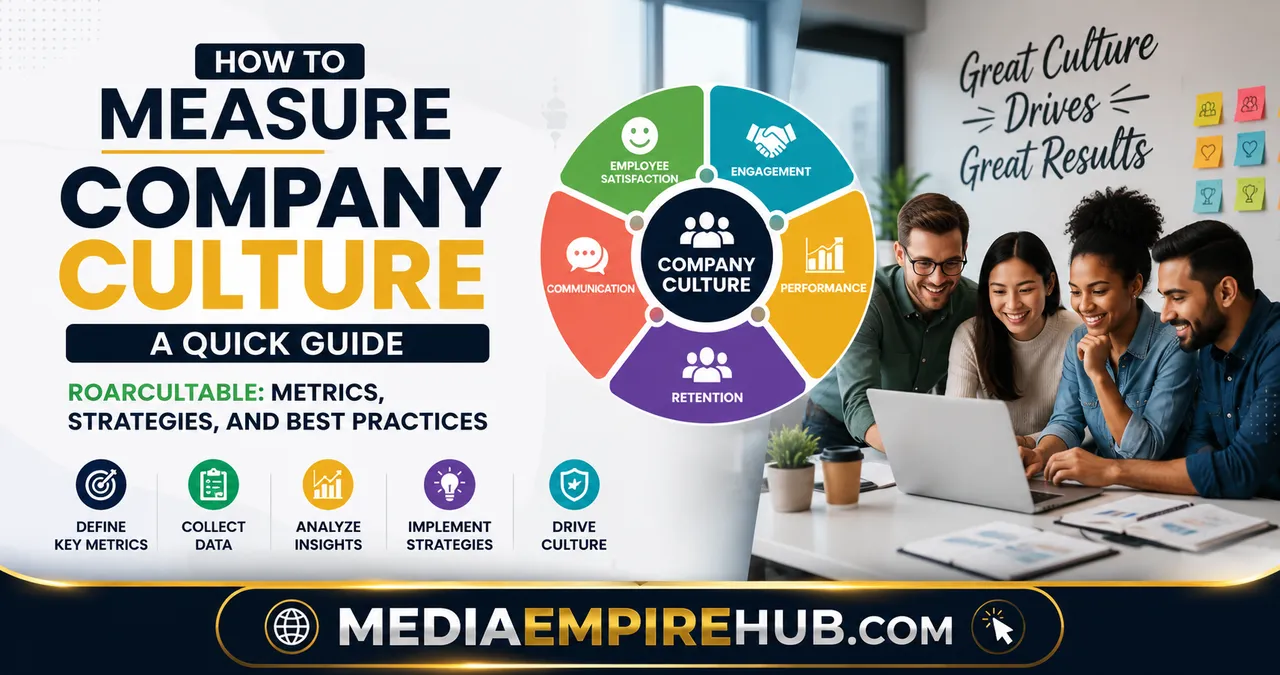
Company culture is one of those things everyone talks about but almost nobody measures properly. You hear it in job interviews, on LinkedIn posts, and in every “we’re a family here” pitch during onboarding. Yet when you ask most leadership teams to show you a number, a chart, or a report that actually proves their culture is healthy, they usually go quiet. That gap between talking about culture and actually measuring it is exactly what this guide is here to close.
If you’re a founder, an HR manager, or someone who just got handed the vague task of “improving our culture,” you already know the frustration. Culture feels soft and squishy, like something you can sense in a room but can’t quite put on paper. The good news is that it absolutely can be measured, tracked, and improved using the same rigor you’d apply to sales numbers or customer retention. This Roarcultable approach breaks down exactly how to measure company culture in a way that is practical, data-backed, and grounded in what actually works inside real organizations, not just theory from a business school textbook.
Why Company Culture Deserves Real Measurement
Most companies treat culture as a feeling rather than a function. Leadership assumes that as long as the office snacks are stocked and the holiday party is fun, everything underneath is fine. But culture is not vibes. It’s the sum of daily behaviors, unspoken rules, communication patterns, and decision-making habits that shape how people actually experience their work. If you never learn how to measure company culture properly, you’re essentially flying blind on one of the biggest drivers of business performance.
Research from Gallup has consistently shown that organizations with strong, well-managed cultures see measurably higher employee engagement and significantly lower turnover than those that don’t track these dynamics at all. That’s not a coincidence. Culture directly touches productivity, innovation, customer service quality, and even how quickly a company can recover from a crisis. If you’re not measuring it, you’re essentially guessing whether your biggest internal asset is helping or quietly hurting your business. And guessing is an expensive habit when the stakes involve retention, reputation, and revenue all at once.
What Company Culture Actually Means Beyond the Buzzword
Before you can figure out how to measure company culture, you need a working definition that goes beyond ping pong tables and casual Fridays. Culture is the collective set of values, beliefs, and behaviors that determine how work actually gets done inside an organization. It shows up in how disagreements are handled, how mistakes are treated, how promotions are decided, and whether people feel safe speaking up in a meeting. It’s less about what’s written in the employee handbook and more about what actually happens when nobody’s watching.
There’s a well-known saying often attributed to management thinker Peter Drucker: “Culture eats strategy for breakfast.” That line gets quoted so often it’s become a cliché, but it holds up because it captures something true. You can have the most brilliant business plan on paper, but if the underlying culture is dysfunctional, that plan will stall the moment it meets real people with real incentives and real fears. Culture is the operating system, and strategy is just the app running on top of it. When you understand this distinction clearly, it becomes obvious why leaders can’t afford to leave culture measurement to guesswork.
The Business Case for Measuring Culture
Executives love numbers, and rightly so, because numbers drive decisions. If you want leadership buy-in to invest time and resources into culture work, you need to frame it in business terms rather than soft HR language. Companies that actively measure company culture tend to outperform their peers on metrics like employee retention, customer satisfaction, and even stock performance over time, according to multiple studies referenced by Harvard Business Review. That’s a powerful argument when you’re trying to convince a skeptical CFO that culture surveys aren’t a waste of budget.
There’s also a defensive angle to consider. Toxic culture has been cited repeatedly, including in reporting from Forbes, as one of the top reasons employees quit their jobs, often outranking compensation as a driver of attrition. Losing a single mid-level employee can cost a company anywhere from half to twice that person’s annual salary once you factor in recruiting, onboarding, and lost productivity. When you multiply that across dozens or hundreds of departures caused by a broken culture, the financial argument writes itself. Measuring culture isn’t a nice-to-have HR exercise; it’s risk management for one of your most expensive assets, which is your workforce.
Key Indicators That Reveal Cultural Health
This raises the practical question of how to measure company culture without turning it into an abstract philosophical debate. The trick is identifying concrete indicators that reflect the underlying health of your workplace, even if culture itself feels intangible. Think of these indicators as vital signs, similar to how a doctor checks blood pressure and heart rate without needing to see inside your entire body to understand your overall health.
Some of the most reliable indicators include employee turnover rates, absenteeism patterns, internal promotion rates, engagement survey scores, and the tone of exit interviews. You can also look at more behavioral signals, like how quickly people respond to internal messages, how often team members recognize each other’s work, or how many ideas get raised and implemented from lower levels of the organization. None of these numbers tell the whole story on their own, but together they paint a fairly accurate picture of whether your culture is thriving or quietly decaying beneath a polished exterior.
It helps to think of these indicators in two buckets: lagging signals and leading signals. Lagging signals, like turnover and exit interview themes, tell you about problems that have already fully developed, often months after the underlying dissatisfaction first took root. Leading signals, on the other hand, like participation rates in optional initiatives, speed of internal referrals, or the volume of employee-submitted ideas, tend to shift earlier and give leadership a chance to intervene before a problem shows up as a resignation letter. A mature approach to culture measurement tracks both categories side by side, using leading indicators as an early warning system and lagging indicators as confirmation of whether past interventions actually worked.
Employee Engagement Surveys and What They Really Tell You
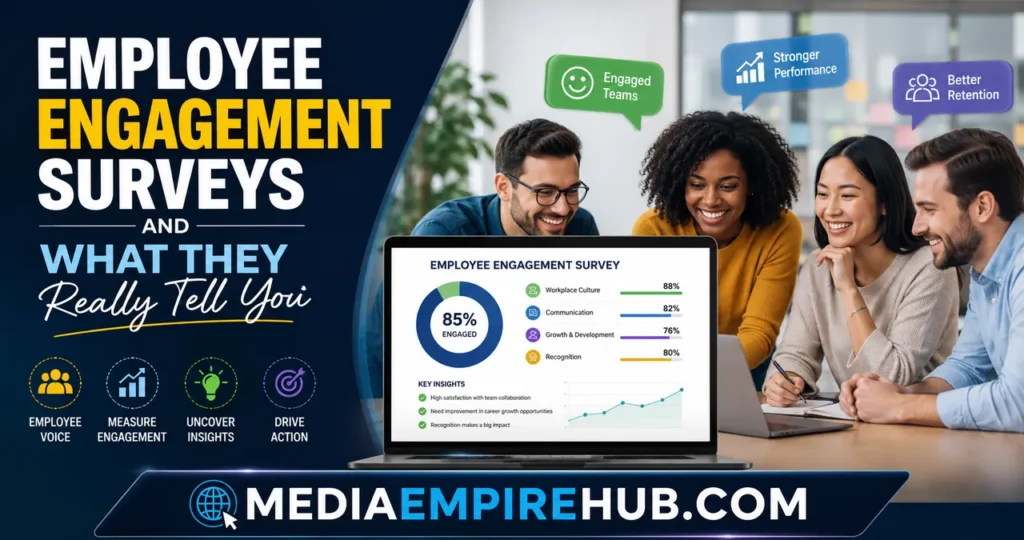
Engagement surveys remain one of the most direct answers to how to measure company culture, provided they’re designed and interpreted correctly. A good survey doesn’t just ask “Are you happy at work?” because that question is too vague to generate useful data. Instead, it should dig into specific dimensions like psychological safety, clarity of expectations, trust in leadership, and perceived fairness in how decisions get made across teams.
The mistake many companies make is running these surveys once a year, collecting the data, and then doing absolutely nothing visible with it. That silence after a survey is arguably worse than not surveying at all, because it signals to employees that their feedback doesn’t actually matter. If you’re serious about how to measure company culture through surveys, commit to closing the loop by sharing results transparently and outlining at least one or two concrete actions the company will take in response. Employees don’t expect perfection, but they do expect to be heard, and that expectation alone can shape how honestly they answer the next survey you send.
Turnover and Retention as Culture Signals
Turnover data is one of the most underused tools for reading a workplace’s true health, mostly because people assume it only reflects compensation issues. In reality, voluntary turnover is often a lagging indicator of cultural problems that existed long before the resignation letter landed on a manager’s desk. When you break down turnover by department, tenure, and manager, patterns start to emerge that point directly at cultural weak spots rather than industry-wide pay trends.
For example, if one specific team consistently loses people within their first six months while other teams retain staff for years, that’s rarely a coincidence tied to salary bands. It usually points to a specific manager’s leadership style, unclear role expectations, or a toxic dynamic within that particular group. Exit interviews, when conducted by a neutral third party rather than the departing employee’s direct manager, can surface honest feedback that never shows up in engagement surveys because people finally feel free to speak without fear of retaliation. Tracking these patterns over time gives you a much clearer, unfiltered lens into your actual culture than any glossy internal newsletter ever could.
Glassdoor Reviews and Public Perception Metrics
External perception matters just as much as internal sentiment when you’re trying to get a complete picture of your workplace. Sites like Glassdoor, Indeed, and even LinkedIn comment sections offer a window into how current and former employees describe their experience when they think no one from leadership is watching. While these reviews should always be taken with some healthy skepticism, since disgruntled former employees and overly enthusiastic recruiters can both skew the data, patterns across dozens or hundreds of reviews tend to reveal genuine themes.
Pay close attention to recurring words and phrases rather than isolated complaints. If multiple reviews across different time periods mention burnout, favoritism, or poor communication from leadership, that’s a signal worth investigating internally rather than dismissing as noise. On the flip side, consistent praise for mentorship, flexibility, or transparent leadership suggests you’re doing something right that’s worth reinforcing and scaling. Companies serious about culture measurement often track their Glassdoor rating trends the same way they’d track a Net Promoter Score, watching for movement over quarters rather than reacting to single reviews.
Using Net Promoter Score for Culture (eNPS)
Borrowed from the world of customer experience, the employee Net Promoter Score, or eNPS, has become a popular shorthand answer to how to measure company culture in a single, trackable number. The concept is simple: ask employees how likely they are, on a scale of zero to ten, to recommend their workplace to a friend or former colleague. Subtract the percentage of detractors from the percentage of promoters, and you get a score that’s easy to track over time and compare across departments or locations.
The appeal of eNPS lies in its simplicity, but that simplicity is also its biggest limitation. A single number can’t explain why people feel the way they do, which is why smart organizations pair eNPS with a follow-up open-text question asking employees to explain their score in their own words. This qualitative layer transforms a shallow metric into something genuinely actionable. Tracking eNPS quarterly, rather than annually, also helps you catch cultural shifts in near real time, especially after major organizational changes like layoffs, leadership transitions, or a sudden shift to remote work policies.
Observing Behavior in Meetings and Daily Interactions
Numbers and surveys only tell part of the story, which is why direct observation remains an essential, if often overlooked, part of the process. How people behave in meetings reveals more about actual culture than almost any written policy document ever could. Do people interrupt each other freely, or does everyone wait patiently for their turn? Does junior staff feel comfortable disagreeing with a senior executive, or does the room go silent whenever leadership speaks?
These behavioral patterns are difficult to quantify with a spreadsheet, but they’re incredibly telling once you know what to look for. Leaders who genuinely want to understand their culture should sit in on meetings across different departments, not just their own leadership team’s sessions, and pay attention to who talks, who stays quiet, and how conflict gets resolved. Similarly, watching how teams handle mistakes says a lot about psychological safety. A culture that treats errors as learning opportunities looks very different from one where people scramble to hide problems out of fear of blame, and that difference shows up in innovation rates, speed of problem-solving, and overall trust within teams.
A Practical Comparison of Culture Measurement Methods
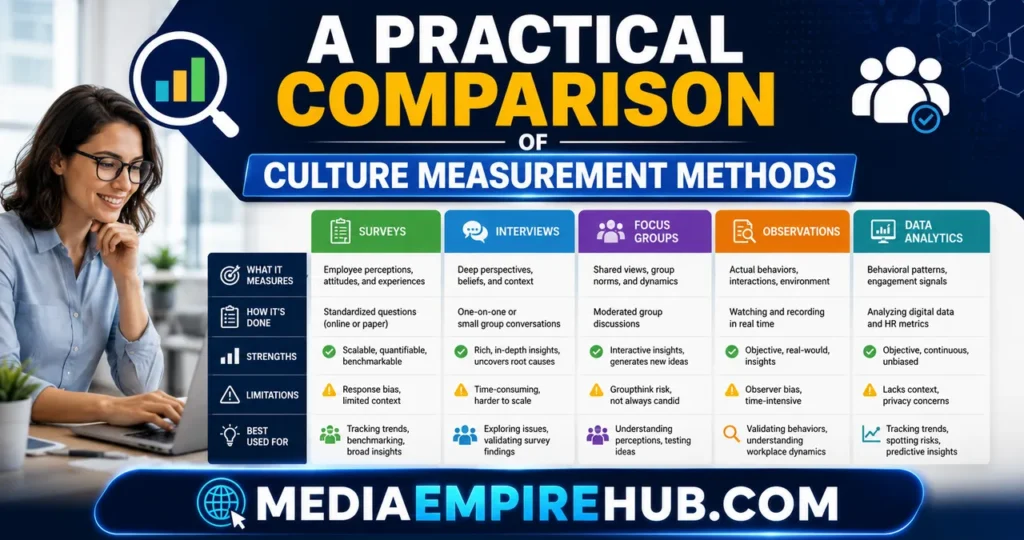
Different measurement methods serve different purposes, and combining several usually gives a far more accurate picture than relying on just one. The table below breaks down some of the most common approaches, along with their strengths and limitations, to help you decide which combination fits your organization’s size and needs.
| Measurement Method | What It Captures | Best For | Limitation |
|---|---|---|---|
| Engagement Surveys | Employee sentiment on trust, clarity, and satisfaction | Companies of any size wanting structured data | Can suffer from survey fatigue if overused |
| eNPS | A quick pulse on overall employee loyalty | Tracking trends over short time periods | Lacks depth without follow-up questions |
| Exit Interviews | Honest feedback from departing employees | Identifying root causes of turnover | Only captures perspective after someone has already decided to leave |
| Turnover and Retention Data | Patterns in who stays and who leaves | Spotting department or manager-specific issues | Requires historical data to be meaningful |
| Glassdoor and Public Reviews | External perception and reputation | Benchmarking against competitors | Can be skewed by extreme reviewers on either end |
| Direct Observation | Real behavior in meetings and daily work | Uncovering unwritten cultural norms | Time-consuming and requires trained observers |
Using this table as a starting point, most organizations find that a blend of quantitative tools like surveys and eNPS, paired with qualitative methods like exit interviews and direct observation, gives the most reliable and complete picture. Relying on just one method, especially something as narrow as an annual survey, almost always leaves significant blind spots that only surface once a problem has already grown too large to ignore quietly.
Common Mistakes Companies Make When Measuring Culture
Even well-intentioned organizations trip over the same mistakes repeatedly when they try to figure out how to measure company culture the right way. One of the most common errors is treating culture measurement as a one-time project rather than an ongoing process. Culture shifts constantly, influenced by new hires, leadership changes, market pressures, and even world events, so a single snapshot from eighteen months ago tells you almost nothing about where things stand today.
Another frequent misstep involves collecting data but failing to segment it properly. A company-wide engagement score of seventy-five percent might sound reassuring on the surface, but that average could be hiding a department scoring below forty percent while another scores in the nineties. Averages flatten nuance, and nuance is exactly what you need to make meaningful improvements. Similarly, many organizations make the mistake of only surveying current employees while ignoring the rich, honest feedback available from those who’ve already left. Combining these data sources, and slicing them by team, tenure, and role level, is what separates surface-level culture tracking from genuinely useful measurement.
A third common mistake worth naming is survey fatigue caused by asking too many questions too often without ever explaining why. When employees are hit with a fifty-question survey every single month, response rates crater and the people who do respond start rushing through it just to get it over with, which quietly corrupts your data without anyone noticing the decline in quality. Shorter, more focused surveys sent at a sustainable cadence, paired with clear communication about why the questions matter, almost always produce more honest and usable results than an exhaustive questionnaire nobody actually wants to complete thoughtfully. Respecting people’s time signals that leadership values substance over the appearance of thoroughness, and that respect tends to show up in the honesty of the answers you eventually receive.
How Leadership Influences Cultural Metrics
You cannot separate culture measurement from leadership behavior, because leaders are often the single biggest variable affecting every metric on this list. Employees don’t quit companies; they quit managers, as the old HR saying goes, and there’s a substantial body of research backing that claim up. When you see poor engagement scores or high turnover concentrated within a specific team, the root cause is almost always tied to how that team’s leader communicates, delegates, and handles conflict.
This is why smart organizations don’t stop at company-wide metrics but push measurement down to the team and manager level. Leadership 360-degree feedback, where managers are reviewed anonymously by their direct reports, peers, and superiors, offers a powerful supplementary tool for reading culture at a granular level. It’s uncomfortable for some leaders to receive this kind of feedback, but discomfort is often exactly where the most useful insights live. As one HR consultant I’ve worked alongside put it during a culture audit project, “You can’t fix what leadership refuses to see about itself, and no survey will save a culture where the people at the top are exempt from scrutiny.”
Beyond formal feedback tools, it’s worth watching how leaders respond when culture data actually reveals something unflattering about their own team. Defensive reactions, quiet dismissal of the numbers, or blaming external factors like “the market” or “this generation of workers” are all signs that leadership development needs just as much attention as the measurement system itself. Leaders who instead treat critical feedback as useful information, ask clarifying follow-up questions, and visibly adjust their behavior tend to see their team’s scores improve over subsequent survey cycles, which itself becomes a strong internal case study for why honest measurement is worth the initial discomfort it can cause.
Turning Data Into Actionable Culture Improvements
Collecting data is the easy part; the real challenge lies in turning that data into meaningful action. Too many companies gather impressive dashboards full of engagement scores and turnover trends, only to let that information sit untouched in a folder somewhere until next year’s survey rolls around. If you want to genuinely understand how to measure company culture in a way that drives change, you need a clear process for translating findings into specific, owned action items.
Start by identifying the two or three most urgent issues surfaced by your data, rather than trying to fix everything at once, which almost always leads to diluted effort and no visible progress. Assign clear ownership to each action item, with a named individual accountable for driving that change forward, and set a realistic timeline for follow-up measurement. This is similar to how solo professionals and small firms approach operational scaling, where prioritizing a few high-impact changes beats spreading thin resources across too many initiatives at once, a principle explored well in this guide on scaling without hiring full-time staff. Culture improvement works the same way: focused, well-resourced changes beat scattered, underfunded ones every time.
Industry Examples and Quotes from Experts
Looking at how different organizations approach culture measurement can offer useful perspective beyond theory. Patty McCord, the former Chief Talent Officer at Netflix, famously helped shape a culture built around radical honesty and high performance, and she’s often quoted saying that “the best thing you can do for employees is hire only ‘A’ players to work alongside them,” reflecting Netflix’s belief that culture is shaped as much by who you hire and retain as by any survey or policy. Whether or not every organization can replicate that exact philosophy, the underlying lesson holds: culture measurement should inform hiring and retention decisions, not just sit in an HR report. The Society for Human Resource Management has published extensively on how deliberate culture-building directly supports business outcomes like retention and productivity, reinforcing that this isn’t just a Silicon Valley talking point but a broadly documented best practice across industries.
Similarly, workplace culture researchers frequently point to physical environment as an underappreciated cultural signal, something worth considering even for smaller teams working out of tight office spaces. The way a workspace is laid out can quietly shape collaboration patterns and morale, a concept explored thoughtfully in this piece on designing small spaces smartly, which, while focused on home environments, offers principles about layout and flow that translate surprisingly well into office culture design. A cramped, poorly organized workspace can undermine even the best-intentioned culture initiatives, simply because physical friction breeds interpersonal friction over time.
Building a Continuous Culture Measurement System
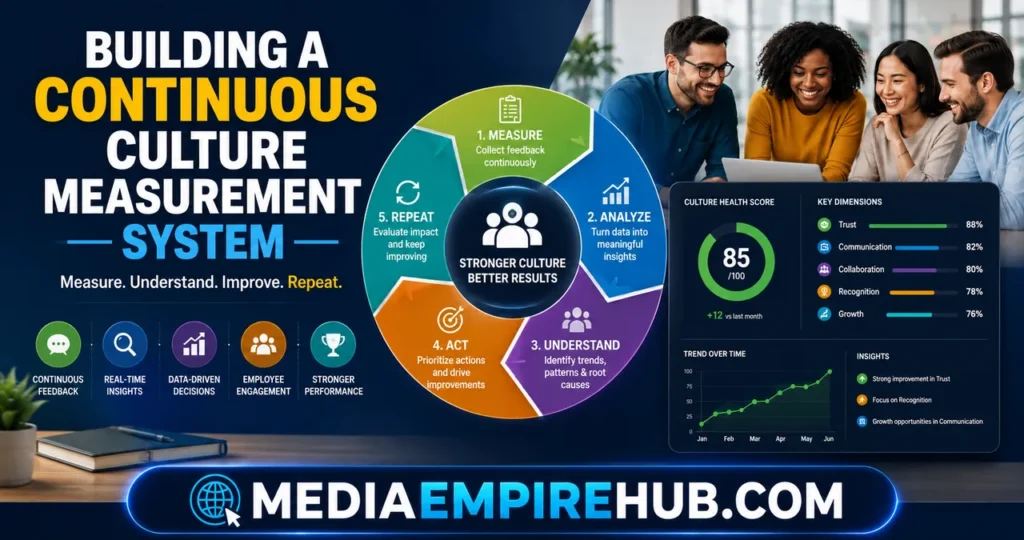
The organizations that get the most value from culture work treat measurement as an ongoing rhythm rather than an annual event. This means setting up a cadence where pulse surveys go out quarterly, eNPS gets tracked monthly, and turnover data gets reviewed at least every quarter alongside broader business metrics. Consistency here matters far more than perfection in any single survey design, because trends over time reveal far more than any isolated snapshot ever could.
It also helps to designate clear ownership over this system, whether that’s an HR business partner, a dedicated People Ops team, or, in smaller companies, a founder who commits to reviewing culture data with the same seriousness as financial statements. For businesses navigating growth and structural decisions more broadly, resources like this business infoguide on leveraging growth strategies offer helpful complementary context on how operational systems, including culture measurement, need to scale alongside the business itself rather than being bolted on as an afterthought once problems have already taken root. A continuous system also creates a paper trail that proves invaluable during moments of organizational stress, similar to how documented protections matter in unrelated but structurally similar situations, such as understanding what a policy actually covers, the way this piece on renters insurance and mold damage highlights the importance of knowing exactly what’s covered before a problem forces the question. Culture data works the same way: you want the documentation and tracking systems in place before a crisis forces you to scramble for answers.
Practical Steps to Start Measuring Culture This Quarter
If everything above feels like a lot to absorb at once, the good news is that you don’t need a massive HR department or expensive software to begin. Start small by launching a short, focused pulse survey with no more than ten questions, targeting specific dimensions like trust in leadership, clarity of role expectations, and perceived fairness. Keep the survey anonymous, promise a clear timeline for sharing results, and actually follow through on that promise, because credibility here compounds over time.
Next, pull your existing turnover data from the past twelve to eighteen months and segment it by department, tenure, and manager to spot patterns you might have missed while looking at company-wide averages. Pair this with a review of your public reviews on sites like Glassdoor, looking specifically for recurring themes rather than isolated complaints. Within a single quarter, you can realistically build a foundational picture of your culture using nothing more than a survey tool, a spreadsheet, and genuine curiosity about what your data is trying to tell you. This lean approach to how to measure company culture proves that meaningful insight doesn’t require a massive budget, just consistent attention and a willingness to act on what you find.
Why Consistency Matters More Than Perfection
One trap that catches even well-intentioned leaders is waiting for the “perfect” survey or measurement system before starting. This perfectionism becomes a form of procrastination, delaying real insight for months or years while culture problems continue compounding beneath the surface. A slightly imperfect survey that actually gets sent out and acted upon will teach you far more than a theoretically perfect one that never leaves the planning stage.
The same logic applies to how you respond to the data once you have it. You don’t need to solve every cultural issue in a single sweeping initiative. Small, consistent adjustments, communicated transparently and followed through on reliably, build far more trust than an ambitious overhaul that fizzles out after the first few weeks. Employees notice patterns of follow-through far more than they notice grand announcements, and that pattern recognition is ultimately what determines whether your culture efforts translate into genuine, lasting improvement or just another forgotten initiative.
Measuring Culture in Remote and Hybrid Teams
Remote and hybrid work has made culture measurement both more important and more complicated at the same time. When people aren’t sharing a physical office, the usual cues leaders rely on, like overhearing a tense conversation or noticing someone’s body language during a tough meeting, simply disappear. That loss of ambient information means companies operating remotely need to be far more intentional about collecting signals that used to arrive passively through everyday office life.
This is where digital communication patterns become surprisingly useful data points. Response times on messaging platforms, meeting camera-on rates, and participation levels in optional virtual events can all serve as rough proxies for engagement, though none of them should be treated as definitive on their own. A sudden drop in participation from someone who used to be vocal in team calls is worth a quiet check-in, not because it’s necessarily a red flag, but because remote environments make it easy for disengagement to go unnoticed for months. Pairing these behavioral signals with regular, well-designed pulse surveys gives remote-first companies a fighting chance at catching cultural drift before it becomes a full-blown retention crisis.
Hybrid teams face their own unique wrinkle, since culture measurement needs to account for two very different daily experiences existing side by side. Employees who come into the office several days a week often have access to informal mentorship, spontaneous collaboration, and visibility with leadership that fully remote colleagues simply don’t get, even if both groups technically have the same job title and reporting structure. Smart organizations segment their engagement data by work arrangement, comparing scores and sentiment between in-office, hybrid, and fully remote employees to spot gaps in belonging or opportunity before they harden into resentment. Ignoring this split is one of the fastest ways to let a two-tiered culture form without anyone at the top realizing it’s happening until turnover data starts telling an uncomfortable story.
The Role of Recognition and Communication Patterns
Recognition, or the lack of it, is one of the most consistent threads running through culture research, yet it rarely gets the attention it deserves compared to flashier metrics like compensation or benefits. Employees who feel their contributions go unnoticed tend to disengage quietly long before they update their resume, which makes recognition frequency a valuable, if underused, signal. Tracking how often peer-to-peer recognition happens, whether through a formal platform or simply observing shoutouts in team meetings, offers a surprisingly reliable window into whether a culture genuinely values its people or just says it does in the employee handbook.
Communication patterns tell a similarly revealing story. Cultures with genuine psychological safety tend to show more horizontal communication, meaning ideas and pushback flow freely between peers and even upward toward leadership, rather than information moving strictly top-down through rigid hierarchy. You can get a rough sense of this by looking at who speaks up in cross-functional meetings, how often junior employees propose ideas that actually get adopted, and whether disagreement with a manager’s decision is treated as constructive input or career risk. None of these observations require sophisticated software, just consistent attention paid over weeks and months rather than a single meeting used as a snapshot.
Written communication, particularly internal email and messaging tone, offers another layer worth watching. Cultures under strain often show subtle shifts, like increased use of formal, defensive language, longer response delays on sensitive topics, or a rise in messages copied to extra people as a kind of self-protective documentation. These aren’t things you’d typically capture in a survey question, but leaders who pay attention to these textures of daily communication often spot cultural erosion months before it shows up in a formal engagement score. Combining this kind of qualitative pattern-watching with your quantitative survey data rounds out a measurement approach that captures both the numbers and the lived texture of how people actually experience working at your company.
Benchmarking Your Culture Data Against Industry Standards
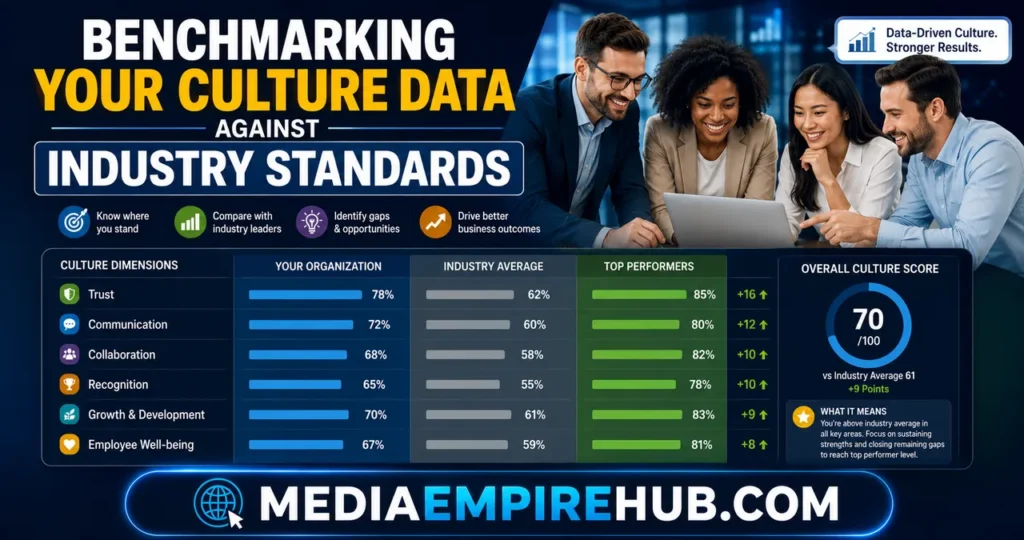
Raw numbers only mean so much without context, which is why benchmarking matters once you’ve started collecting reliable culture data. An eNPS score of thirty might sound mediocre in isolation, but if your industry average sits closer to ten, that same score suddenly looks like a genuine competitive advantage worth highlighting in recruiting materials. Without this comparative lens, companies often either panic over numbers that are actually quite healthy relative to their sector, or worse, feel falsely reassured by scores that are mediocre compared to what similar organizations are achieving.
Industry associations, HR research firms, and platforms like Glassdoor often publish aggregate benchmarking data broken down by sector and company size, giving you a reasonable starting point for comparison even if exact figures vary by source. Fast-growing startups, for instance, tend to see naturally higher turnover than established enterprises simply due to the nature of rapid scaling and shifting role requirements, so comparing your churn rate against a mature Fortune 500 company would give you a skewed and unhelpful picture. Seeking out benchmarks from organizations genuinely similar to yours in size, industry, and growth stage produces a far more useful frame of reference than chasing generic, one-size-fits-all targets pulled from unrelated sectors.
It’s also worth remembering that benchmarks should inform your goals without becoming an excuse to dismiss legitimate internal problems. A company might point to an industry-average turnover rate and conclude their own numbers are “normal,” even when exit interviews are clearly surfacing a specific, fixable leadership issue within one department. Benchmarking works best as a sanity check on how you’re doing relative to peers, not as a shield against addressing problems your own data has already flagged as worth fixing. Used thoughtfully, external comparison sharpens your priorities rather than replacing the harder internal work of actually listening to what your people are telling you.
Getting Employee Buy-In for Culture Measurement Efforts
None of these measurement methods work particularly well if employees view them with suspicion or treat survey requests as just another box-ticking exercise handed down from leadership. Building genuine buy-in starts with transparency about why the data is being collected and, just as importantly, what will and won’t be done with it. Employees are far more willing to answer honestly when they understand that a survey exists to drive real change rather than to generate a report that gets filed away and forgotten until the next annual cycle.
Anonymity plays a critical role here too, particularly in smaller teams where individual responses could theoretically be traced back to a specific person based on role or department size. If employees suspect their honest feedback could be identified and used against them, even subtly, response quality drops sharply and people default to safe, noncommittal answers that tell you almost nothing useful. Using third-party survey tools rather than internally built systems, and aggregating results at a team level rather than displaying individual responses, helps preserve the psychological safety needed for genuinely candid feedback to surface in the first place.
Perhaps the most powerful driver of buy-in, though, is visible follow-through. When employees see that a previous survey led to an actual policy change, a new manager training program, or a shift in how promotions get decided, they start to trust that the next survey is worth their time and honesty. This trust compounds over multiple survey cycles, creating a virtuous loop where better participation leads to richer data, which leads to more targeted action, which in turn drives even stronger participation the next time around. Skipping this follow-through step, even once, can set that trust-building process back significantly, which is exactly why closing the loop deserves as much planning attention as the survey design itself.
Conclusion
Measuring company culture isn’t about chasing a perfect score or producing a glossy report for the next board meeting. It’s about building an honest, ongoing feedback loop that tells you the truth about how people actually experience your organization, even when that truth is uncomfortable. Combining quantitative tools like engagement surveys and eNPS with qualitative methods like exit interviews and direct observation gives you a far richer, more accurate picture than relying on gut instinct or the occasional anonymous complaint that reaches leadership.
The organizations that treat culture measurement as seriously as they treat financial reporting tend to see the payoff in lower turnover, stronger engagement, and a workplace people actually want to stick around for. This Roarcultable approach isn’t about adding more bureaucracy to your business; it’s about replacing assumptions with evidence, so that when you say your culture is strong, you actually have the data to back that claim up. Start small, stay consistent, and let the numbers guide your next move rather than waiting for culture problems to become too big to ignore.
Frequently Asked Questions About Measuring Company Culture
What is the easiest way to learn how to measure company culture for a small business?
The simplest starting point for a small business is a short, anonymous pulse survey covering trust in leadership, communication clarity, and overall satisfaction, combined with a close look at voluntary turnover patterns. Small teams don’t need expensive software to learn how to measure company culture effectively; a basic survey tool and a spreadsheet tracking departures and their stated reasons can reveal surprisingly clear patterns within just a few months of consistent tracking.
How often should a company measure its culture?
Most experts recommend a layered approach, with lightweight pulse checks happening monthly or quarterly and more comprehensive engagement surveys conducted twice a year. This cadence allows you to stay on top of your culture frequently enough to catch emerging issues before they escalate, without overwhelming employees with excessive surveys that lead to fatigue and declining response rates over time.
Can employee turnover alone tell you if your culture is healthy?
Turnover is a valuable signal but should never be used in isolation, since low turnover can sometimes mask disengagement in employees who stay simply because they lack better options elsewhere. To properly understand how to measure company culture, turnover data works best when paired with engagement scores, exit interview themes, and manager-level breakdowns that reveal whether people are staying because they’re genuinely satisfied or simply staying out of inertia.
What role does leadership play in cultural measurement?
Leadership behavior is often the single biggest driver behind whatever your culture metrics reveal, since managers directly shape how employees experience communication, recognition, and fairness on a daily basis. Including 360-degree feedback and manager-specific engagement breakdowns in your process ensures that leadership accountability stays central to it, rather than treating culture as something that exists separately from how people at the top actually behave.
Is it possible to measure company culture without expensive HR software?
Absolutely, and many smaller organizations do exactly this using free survey tools, basic spreadsheets, and structured exit interviews conducted by a neutral party. While dedicated HR platforms can streamline the process at scale, the fundamentals of how to measure company culture, consistent surveys, honest exit conversations, and careful data segmentation, don’t require significant financial investment to execute well, especially in the early stages of building a measurement system.
How do you know if your culture measurement efforts are actually working?
You’ll know your culture-tracking efforts are working when you see measurable improvement in the specific metrics you targeted, whether that’s rising engagement scores, declining turnover in a previously troubled department, or improved sentiment in exit interviews and public reviews. Just as important, though, is whether employees themselves report feeling heard and noticing visible changes tied back to the feedback they provided, since that perception of responsiveness is often what sustains honest participation in future measurement efforts.