
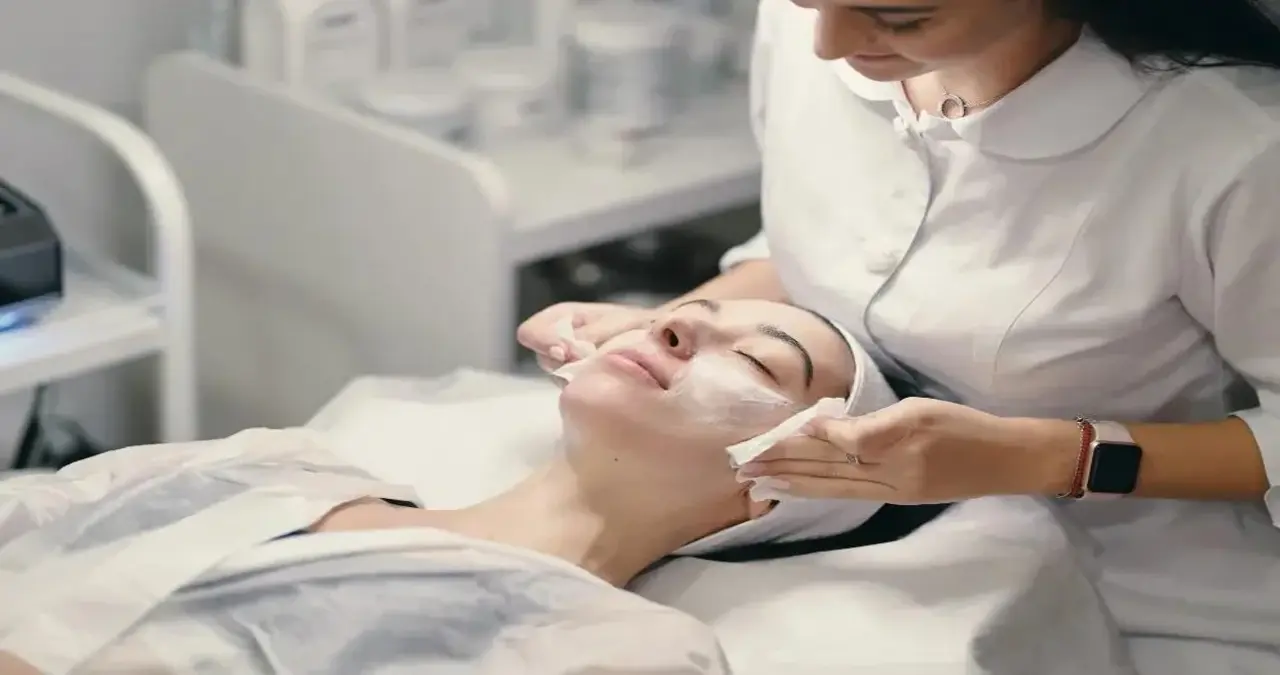
After a decade of lasers and devices, the century-old chemical peel is the treatment London clinics can’t keep up with — and the reasons have nothing to do with nostalgia.
Every few years, the beauty industry rediscovers something its grandmothers knew. Retinol came back. Facial massage came back. And now — after a decade in which lasers, microneedling devices and injectables dominated every aesthetic clinic’s menu — the chemical peel is having its renaissance.
The numbers tell the story: peels consistently rank among the most-performed non-surgical procedures worldwide, and practitioners across the UK report that demand has climbed sharply, driven by a generation of patients who arrived expecting high-tech devices and left asking for an acid with a century of history behind it.
The oldest trick in the book
Chemical exfoliation is genuinely ancient — the fashionable origin story cites sour milk baths (lactic acid, as it happens) — but the modern medical peel dates to dermatology’s early twentieth century. The principle has never changed: apply a controlled acid solution to the skin, remove the damaged outer layers at a chosen depth, and let the skin’s own renewal do the rest — fresher surface cells, stimulated collagen, more even tone.
What has changed is precision. The blunt, week-of-hiding deep peels of the 1990s have given way to a sophisticated toolkit of targeted acids at carefully controlled strengths:
- Mandelic acid — a large, slow-penetrating molecule, gentle enough for sensitive and darker skin tones, favoured for pigmentation and texture.
- Salicylic acid — oil-soluble, so it travels into pores, making it the workhorse for acne and congestion.
- Glycolic and lactic acids — the classic alpha-hydroxy acids for dullness and fine lines.
- TCA — the deeper option for scarring and significant sun damage, still very much a doctor’s instrument.
Why the comeback?
Three forces explain the peel’s return, and none of them is nostalgia.
The skincare literacy boom. A generation raised on ingredient-list content knows what glycolic acid is before they ever enter a clinic. The professional peel is the logical next step from the 5% home product — same science, clinical strength, applied by someone who knows precisely when to stop.
Realistic downtime. Modern superficial and medium peels fit real lives: a weekend of mild flaking rather than a fortnight in hiding. A typical clinical protocol runs three to six sessions spaced two to six weeks apart, each around 45 minutes, with the acid either timed and neutralised or self-neutralising depending on the formulation. Newer “bio-revitalisation” peels such as PRX-T33 push the category further — a TCA-based formulation engineered to stimulate without frank peeling, popular precisely because most patients experience little to no visible flaking. For patients balancing results against recovery that trade has become the sweet spot — and at £200–£250 per session for doctor-led chemical peels at a London clinic, the entry price undercuts most device-based alternatives by a wide margin.
It plays well with others. Perhaps most importantly, the peel has found its place in modern treatment plans. Clinics increasingly sequence complementary procedures across a course: peels to resurface and even tone, regenerative treatments to rebuild skin quality from beneath. A frequent companion on those plans is the PRP facial — a distinct procedure in its own right, in which a medical microneedling device such as the SkinPen creates thousands of controlled micro-channels at 0.5–1.5mm depth and the patient’s own centrifuge-concentrated plasma is applied topically, letting growth factors penetrate skin that is, quite literally, open to receive them. It is typically scheduled in alternation with peel sessions rather than layered onto them, and documented courses show settled results assessed months after completion, not the flattering next-day glow. Patients interested in how the two approaches complement each other can learn more about PRP facials. Resurfacing outside, regeneration inside: the logic is hard to argue with.
The caveat that matters
The peel’s simplicity is deceptive, and its renaissance has revived an old problem: acids of clinical strength in non-clinical hands. Depth control is everything — the line between an excellent medium peel and a burn is a matter of concentration, timing, skin preparation and the judgement to say “not this acid, not this skin, not today”. Darker skin tones in particular require experienced assessment, since the wrong peel can trigger the very pigmentation problems the patient came to fix.
The professional consensus is boringly consistent: for anything beyond mild superficial peels, choose a medically supervised setting, ask what acid and what concentration is being used and why it suits your skin type, and be suspicious of anyone offering a deep peel without a consultation first.
Old science, new place in the toolkit
The chemical peel never actually went away — dermatologists have used it continuously for a century while fashions cycled around it. What has changed is its billing: no longer the star of the show, but the reliable opening act that makes everything after it work better. In an industry addicted to novelty, there is something quietly satisfying about the comeback of a treatment whose entire pitch is that skin, given a controlled push, still knows how to renew itself.