
Introduction
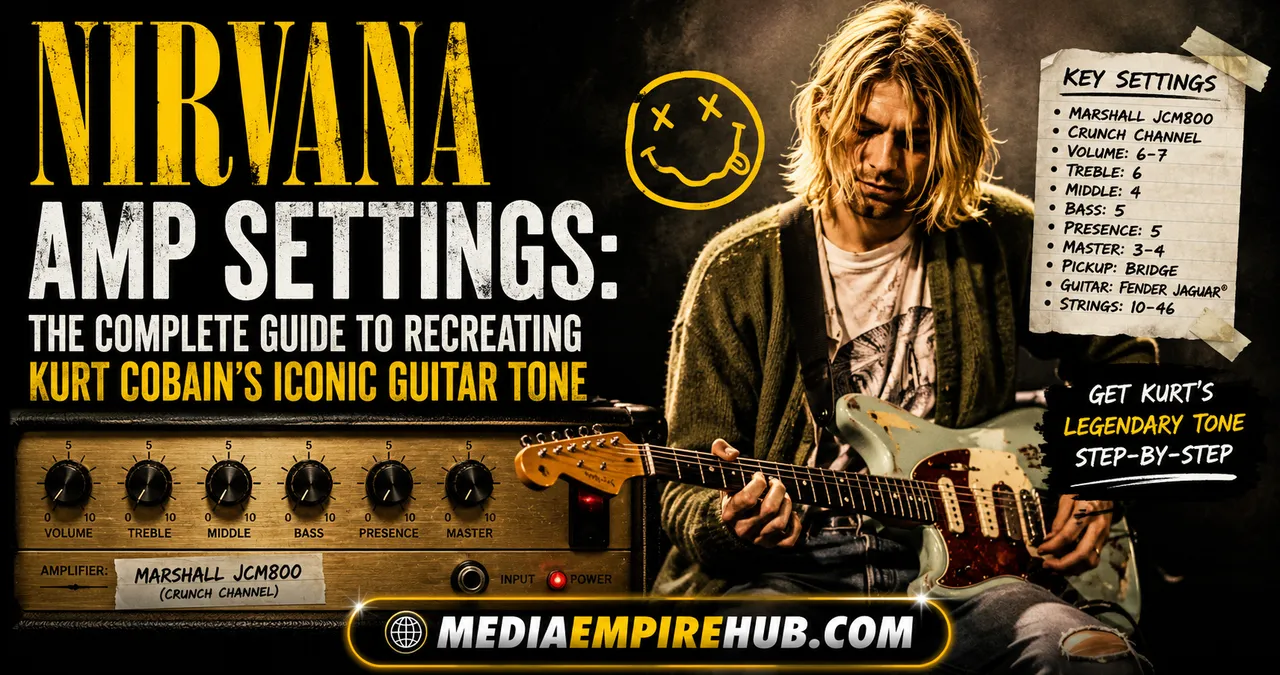
Few guitar tones in rock history are as instantly recognizable as the raw, aggressive, and emotionally charged sound created by Nirvana. Whether it is the explosive chorus of Smells Like Teen Spirit, the haunting atmosphere of Come As You Are, or the dynamic shifts found throughout Nevermind and In Utero, Kurt Cobain’s guitar tone remains one of the most studied sounds in modern music.
For guitar players searching for the ideal Nirvana amp settings, the goal is often much more than simply copying a tone. Cobain’s sound represents an entire musical movement built around authenticity, power, and simplicity. Unlike many guitarists who relied on highly complex rigs, Cobain frequently achieved massive sounds using relatively straightforward equipment and carefully adjusted amplifier settings.
Understanding Nirvana amp settings requires examining several factors, including amplifier EQ, gain structure, speaker response, pedals, and playing style. While exact replication can be difficult because equipment varied throughout Nirvana’s career, players can come remarkably close by understanding the fundamental principles behind Cobain’s tone.
This guide explores the settings, equipment, techniques, and practical adjustments needed to recreate the iconic Nirvana sound while also explaining why those settings continue to influence generations of guitarists today.
What Are Nirvana Amp Settings?
Nirvana amp settings refer to the amplifier configurations commonly used to recreate the guitar tones associated with Kurt Cobain and Nirvana’s recordings and live performances.
Although settings varied depending on the song, venue, and era, most Nirvana tones share several defining characteristics:
- Moderate to high gain
- Strong low-end response
- Slightly scooped mids
- Bright but not harsh treble
- Aggressive power amp dynamics
- Heavy use of distortion pedals
The objective was not technical perfection but emotional impact. Cobain’s sound often embraced imperfections, feedback, and controlled chaos, helping define the grunge movement of the early 1990s.
Understanding Kurt Cobain’s Signature Guitar Sound
Kurt Cobain’s tone combined punk aggression with surprisingly melodic textures.
Several elements contributed to his sound:
| Tone Component | Contribution |
|---|---|
| Distortion | Aggressive attack |
| Chorus Effects | Spacious clean tones |
| EQ Balance | Thick but cutting mix |
| Amplifier Volume | Natural power amp saturation |
| Guitar Pickups | Strong output and clarity |
Unlike many hard rock guitarists, Cobain rarely chased technical precision. Instead, he prioritized emotional expression and song dynamics.
This philosophy significantly influenced his amp settings.
The Core Elements Behind Nirvana’s Tone
When analyzing Nirvana amp settings, three major factors stand out:
1. Amplifier Foundation
Most of Cobain’s rigs were built around high-headroom amplifiers capable of handling heavy distortion pedals.
2. Distortion Pedals
The Boss DS-1 and later the DS-2 Turbo Distortion became central to his sound.
3. Dynamic Playing Style
Many players overlook the importance of attack. Cobain often struck strings aggressively, generating much of the energy associated with Nirvana recordings.
Recommended Nirvana Amp Settings for Beginners
A good starting point for most modern amplifiers is:
| Control | Setting |
|---|---|
| Gain | 6 |
| Bass | 7 |
| Mid | 4 |
| Treble | 6 |
| Presence | 5 |
| Reverb | 2 |
These settings provide a foundation that captures much of the Nirvana character while remaining adaptable to different guitars and amplifiers.
Nirvana Amp Settings for Clean Sounds
Many guitarists associate Nirvana exclusively with distortion, but Cobain frequently used clean tones.
Suggested clean settings:
| Control | Setting |
|---|---|
| Gain | 3 |
| Bass | 6 |
| Mid | 5 |
| Treble | 6 |
| Presence | 5 |
| Chorus | On |
These settings work particularly well for songs like Come As You Are.
Nirvana Amp Settings for Distorted and Grunge Tones
For heavier sounds:
| Control | Setting |
|---|---|
| Gain | 7-8 |
| Bass | 7 |
| Mid | 3-4 |
| Treble | 6 |
| Presence | 5 |
| Distortion Pedal | Active |
The combination produces the thick, explosive tones heard on Nevermind.
Best EQ Settings to Achieve the Nirvana Sound
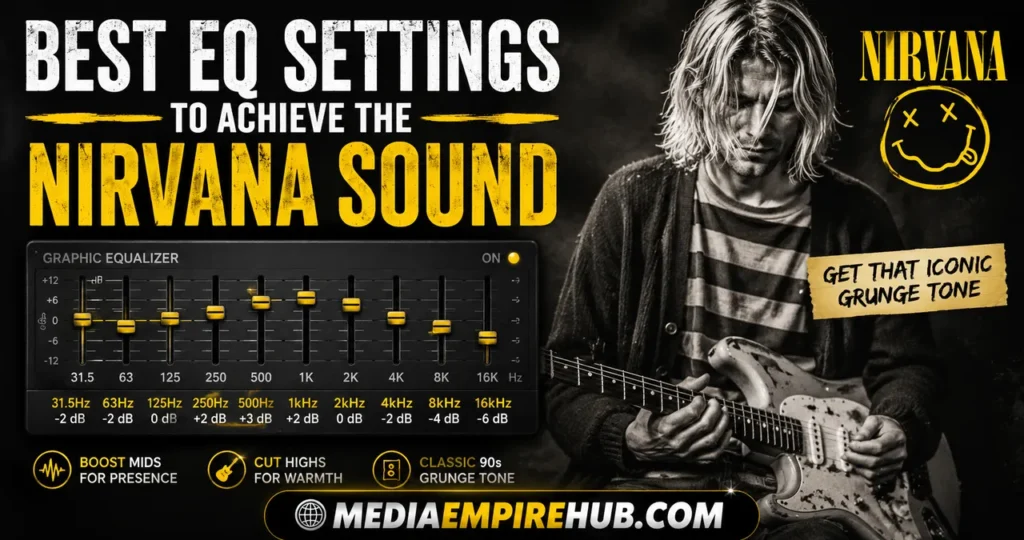
EQ plays a major role in recreating Cobain’s tone.
Bass
Higher bass settings create the weight associated with Nirvana recordings.
Mids
Slightly reduced mids contribute to the grunge aesthetic.
Treble
Moderate treble helps maintain clarity without becoming harsh.
Gain, Bass, Mid, Treble, and Presence Explained
Understanding each control helps players fine-tune their sound.
Gain
Controls distortion intensity.
Bass
Adds low-frequency fullness.
Mid
Shapes body and projection.
Treble
Enhances clarity and attack.
Presence
Adjusts upper-end response and perceived brightness.
Kurt Cobain’s Most Famous Amplifiers
Throughout Nirvana’s career, Cobain used several notable amplifiers.
Mesa/Boogie Studio Preamp
A major component of his touring rigs.
Fender Twin Reverb
Known for its clean headroom.
Marshall Cabinets
Often used for stage projection.
Crown Power Amps
Helped create the powerful live sound fans associate with Nirvana concerts.
How Nirvana Amp Settings Changed Throughout the Years
Bleach Era
- Raw punk tones
- Higher gain
- Less refinement
Nevermind Era
- Cleaner production
- Better EQ balance
- More polished distortion
In Utero Era
- Darker and heavier sound
- Increased aggression
- More experimental textures
Nirvana Amp Settings for Smells Like Teen Spirit
Suggested settings:
| Control | Setting |
|---|---|
| Gain | 7 |
| Bass | 7 |
| Mid | 4 |
| Treble | 6 |
| Presence | 5 |
Pair these settings with a DS-1 distortion pedal for the closest approximation.
Nirvana Amp Settings for Come As You Are
Recommended settings:
| Control | Setting |
|---|---|
| Gain | 3 |
| Bass | 6 |
| Mid | 5 |
| Treble | 6 |
| Chorus | On |
The chorus effect is essential for capturing the song’s atmosphere.
Nirvana Amp Settings for Lithium
Lithium relies heavily on dynamic contrast.
Verse
- Clean channel
- Chorus effect
Chorus
- Distortion engaged
- Gain increased
The dramatic transition between sections is crucial.
Nirvana Amp Settings for In Bloom
For In Bloom:
| Control | Setting |
|---|---|
| Gain | 7 |
| Bass | 7 |
| Mid | 4 |
| Treble | 6 |
These settings emphasize the song’s heavy rhythm guitar character.
Amp Settings for Live Nirvana Performances
Live tones often featured:
- Higher volume
- Increased bass response
- More feedback
- Greater power amp saturation
Concert settings typically differed from studio recordings due to venue acoustics.
Budget-Friendly Ways to Recreate Nirvana’s Tone
You do not need expensive equipment.
Affordable options include:
- Boss DS-1
- Boss DS-2
- Fender Mustang Series
- Boss Katana
- Marshall MG Series
These combinations can produce convincing Nirvana-inspired tones without a large investment.
Recommended Guitar and Pedal Combinations
Popular setups include:
| Guitar | Pedal |
|---|---|
| Fender Mustang | Boss DS-1 |
| Jaguar | DS-2 |
| Stratocaster | DS-1 |
| Mustang HH | DS-2 |
The pickup configuration significantly affects the final result.
Common Mistakes When Dialing in Nirvana Amp Settings
Many players struggle because they:
- Use excessive gain
- Add too much treble
- Ignore playing dynamics
- Overuse effects
- Chase studio perfection
The original Nirvana sound often relied on simplicity rather than complexity.
Real-World Scenario: Building a Nirvana-Inspired Practice Rig
A guitarist with a budget under $500 could achieve impressive results using:
- Boss Katana amplifier
- Boss DS-1 distortion pedal
- Squier Mustang guitar
With proper EQ adjustments, this setup can produce tones remarkably close to classic Nirvana recordings.
Modern Amps That Can Replicate Nirvana Tones
Several current amplifiers work well:
- Boss Katana
- Fender GTX Series
- Marshall DSL Series
- Positive Grid Spark
- Line 6 Catalyst
Each offers flexibility for both clean and distorted Nirvana sounds.
Digital Modeling and Nirvana Amp Settings
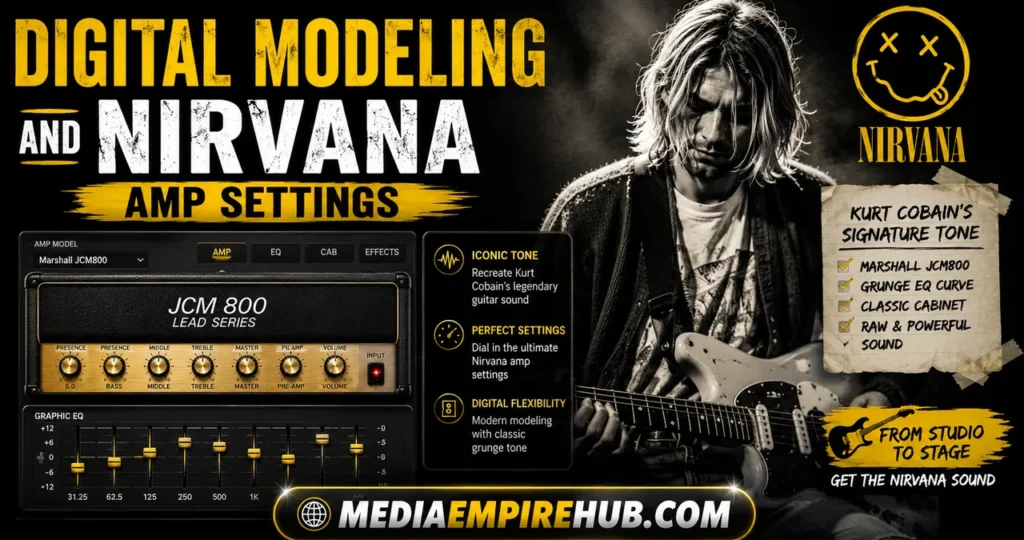
Modern modeling technology allows players to recreate vintage rigs with impressive accuracy.
Benefits include:
- Lower cost
- Preset storage
- Home recording convenience
- Consistent sound quality
Digital platforms have made Nirvana-style tones more accessible than ever.
Why Nirvana’s Guitar Tone Still Influences Modern Rock
Three decades after their breakthrough, Nirvana remains highly influential.
Reasons include:
- Emotional authenticity
- Memorable guitar sounds
- Simplicity of execution
- Powerful songwriting
Many modern alternative and rock artists continue to draw inspiration from Cobain’s approach.
Expert Perspective on Kurt Cobain’s Sound Design
Kurt Cobain’s greatest tonal achievement was not technical sophistication but emotional communication.
His sound proved that memorable guitar tones depend more on musical identity than expensive equipment. The combination of strong songwriting, effective amp settings, and expressive performance created a sound that continues to resonate with musicians worldwide.
Frequently Asked Questions About Nirvana Amp Settings
What gain setting should I use for Nirvana songs?
Most songs work well between 6 and 8 depending on the amplifier.
Did Kurt Cobain use Marshall amps?
He primarily used Mesa/Boogie and Fender equipment, though Marshall cabinets were frequently part of his live rigs.
Which pedal is closest to the Nirvana sound?
The Boss DS-1 is widely considered the most accurate starting point.
Are Nirvana amp settings suitable for beginners?
Yes. The settings are relatively simple and easy to replicate on most amplifiers.
Can digital amps recreate Nirvana tones?
Absolutely. Modern modeling amplifiers can produce highly convincing Nirvana-style sounds.
Conclusion
Nirvana amp settings remain among the most sought-after guitar configurations because they represent far more than a collection of EQ numbers. They capture the raw energy, emotional honesty, and rebellious spirit that defined an entire generation of rock music. By understanding Kurt Cobain’s approach to gain, EQ, distortion, and dynamics, guitarists can recreate many of the tones that helped make Nirvana one of the most influential bands in music history. Whether using vintage gear, modern modeling amps, or budget-friendly equipment, the principles behind Nirvana’s sound remain remarkably accessible, proving that great tone is ultimately about expression rather than complexity.